NFL Weather Impact on Player Prop Odds
 Available in US
December 2022, Buffalo. Wind gusts hitting 35 miles per hour. Josh Allen – one of the strongest arms in football – completed 18 of 34 passes for 172 yards. His passing yards prop that day was set at 265.5. Anyone who checked the weather forecast and took the under cashed comfortably. Anyone who bet the over based on Allen’s season average learned an expensive lesson about variables they’d ignored.
Weather is the most underpriced factor in NFL prop betting. The sportsbook accounts for it, but the adjustment is often conservative because the models rely on historical averages rather than granular meteorological data. The NFL played a record seven international games during the 2025 season, including three in London, where weather conditions at Wembley and Tottenham Hotspur Stadium add another layer of complexity that bettors on both sides of the Atlantic need to account for.
Wind Speed Thresholds for NFL Passing Props
Wind is the enemy of the forward pass, and it starts mattering at lower speeds than most bettors assume. Based on years of tracking weather-adjusted results, I use three wind thresholds as decision points for passing props.
Below 10 mph: minimal impact. The ball flight is barely affected, and passing efficiency stays within normal parameters. I don’t adjust my analysis for wind at this level.
Between 10 and 15 mph: measurable impact on deep balls. Quarterbacks complete fewer passes beyond 20 air yards, which compresses the passing yardage ceiling. The effect is more pronounced for quarterbacks who rely on deep shots – big-armed throwers who stretch the field vertically. For checkdown artists who work the short-to-intermediate game, the effect is minimal.
Above 15 mph: significant impact on all passing metrics. Completion rates drop, air yards per attempt shrink, and interception rates rise. Passing yards props in sustained winds above 15 mph have been some of the most reliably under-hitting markets I’ve tracked. The sportsbook adjusts – maybe dropping the line by five or eight yards from what it would be in calm conditions – but that adjustment consistently underestimates the real-world effect. The under on passing yards in strong wind is the closest thing to a structural edge that weather offers.
One detail that matters: wind direction relative to the field. Crosswinds disrupt passing more than headwinds or tailwinds because they push the ball laterally during flight, making precision throws nearly impossible. A 20 mph tailwind barely affects a quarterback. A 20 mph crosswind reshapes the entire passing game.
Rain, Cold, and Their Impact on Scoring Props
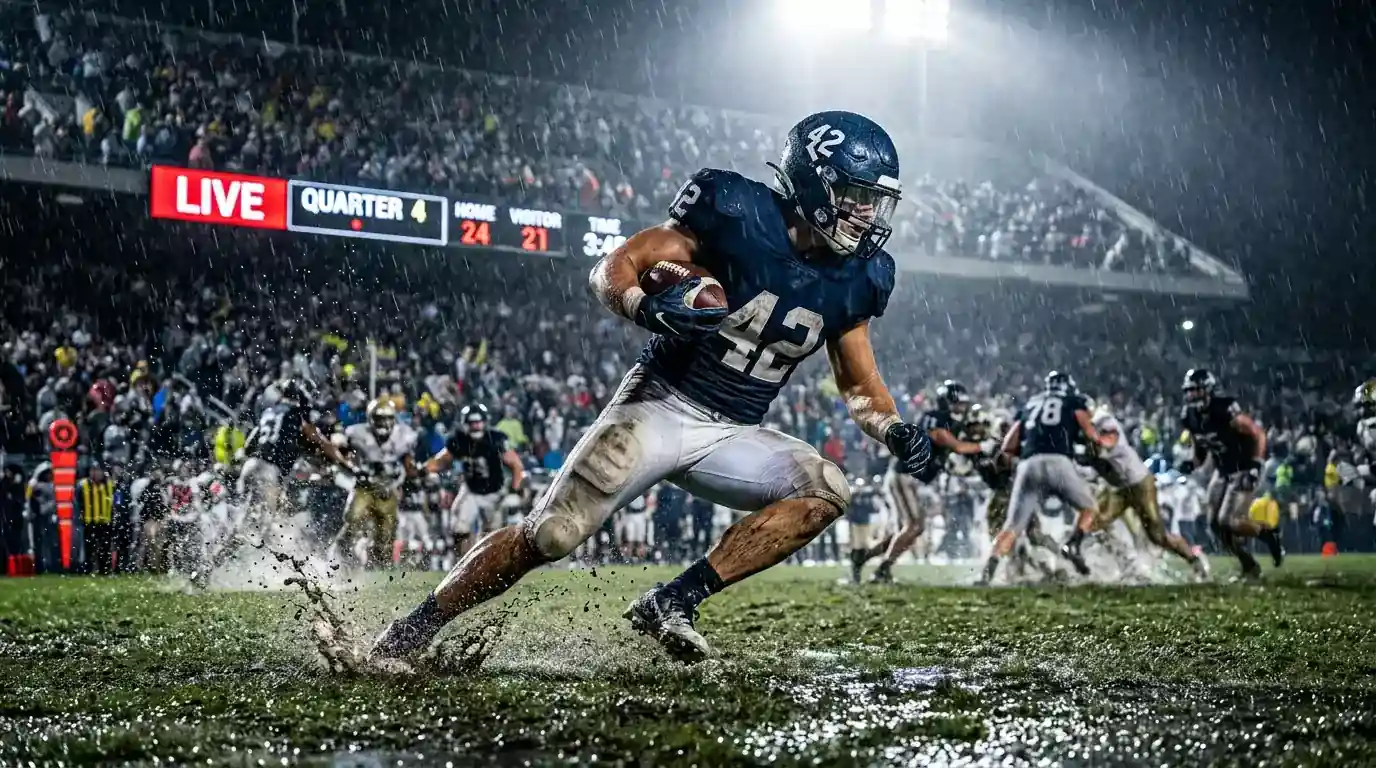
Rain affects football in ways that go beyond wet hands and slippery balls. The deeper impact is on field conditions. As rain accumulates, the turf – especially natural grass – becomes soft and slow. Running backs lose traction on cuts. Receivers can’t plant and break routes cleanly. The entire pace of the game slows down, which suppresses scoring and total yardage for both sides.
Unders on player props win approximately 60% of the time across full NFL seasons according to CBS Sports data. In rainy conditions, that percentage climbs. I’ve found that touchdown props are the most affected category: wet conditions make it harder to execute in the red zone, where the field compresses and footing becomes critical. Running backs slip at the goal line. Receivers can’t separate in tight spaces. The result is more field goals and fewer touchdowns, which makes anytime touchdown scorer props less likely to hit at their standard rates.
Cold alone is less impactful than people assume. NFL players perform in cold weather routinely, and the equipment and conditioning have improved to the point where temperatures above minus five Celsius barely register as a factor. Below that threshold, ball handling becomes an issue – the football hardens, fumble rates increase, and quarterbacks’ grip weakens on throws. Extreme cold combined with wind is the worst-case scenario for passing props, and those games reliably produce scoring outputs well below the pregame lines.
Indoor Stadiums vs Open-Air Venues: A Prop Bettor’s Cheat Sheet
Eight NFL teams play home games in fully enclosed stadiums, and two more have retractable roofs that are usually closed in bad weather. For prop betting purposes, indoor games eliminate weather as a variable entirely. That matters more than you’d think.
Indoor stadiums produce consistently higher passing yardage, higher completion percentages, and more total points than open-air venues. The controlled environment removes noise from the analysis – you can focus purely on matchup, scheme, and talent without worrying about a rogue gust of wind turning a 40-yard completion into an interception.
I weight indoor games differently in my models. When a quarterback who normally plays outdoors travels to an indoor stadium, his passing ceiling rises. The sportsbook adjusts for this, but the adjustment is baked into the line as a static factor rather than a dynamic one. If that same quarterback also faces a poor pass defence, the combination of indoor conditions plus weak opposition creates a stacking effect that the line often doesn’t fully capture.
The reverse is also true. A dome quarterback who travels to a cold, windy outdoor stadium in December is leaving his comfort zone. His career statistics in climate-controlled environments won’t predict his output in 5-degree weather with 18 mph gusts. I keep a simple spreadsheet of quarterback performance split by indoor and outdoor starts. The production gap for some quarterbacks is startling – 30 or 40 yards of difference in average passing output depending on venue type.
For UK bettors eyeing London games, the weather consideration is real but nuanced. Tottenham Hotspur Stadium has a roof that can be closed, while Wembley is open-air. An October game at Wembley in heavy rain plays differently from a September game at Tottenham under roof. Checking the venue and the forecast should be automatic before betting any passing prop for a London fixture. If you’re considering a broader matchup evaluation process beyond weather, defensive rankings for props covers the analytical framework that sits alongside this weather layer.
At what wind speed should I start adjusting passing yard prop expectations?
Sustained wind above 15 mph materially reduces passing production. Between 10 and 15 mph, the effect is measurable on deep balls but less significant for short-passing offences. Below 10 mph, wind has minimal impact on prop outcomes. Crosswinds are more disruptive than headwinds or tailwinds at any speed.
Do NFL London games have unique weather considerations for prop bettors?
Yes. Tottenham Hotspur Stadium has a closable roof, so weather is controlled there. Wembley is open-air and subject to whatever conditions October and November bring in London. Additionally, the travel and jet lag from a transatlantic crossing can affect player performance in ways that interact with weather — cold, rain, and early-morning kickoff times by body clock all compound fatigue.
Written by the editors at nfl Best Player Prop Bets.