NFL Prop Betting Strategy and Value Markets
 Available in US

Three years ago, I placed forty-seven prop bets over a single NFL weekend. I tracked every one of them in a spreadsheet I still use today. The result was not pretty – a net loss that taught me more about this market than any winning streak ever could. The lesson was simple: intuition is expensive. Strategy is what separates the bettors who survive a full season from those who burn through their bankroll by Week 6.
The average hold percentage across US sportsbooks has climbed from 6.7% in 2018 to above 9% in recent seasons, according to industry data compiled by Doc’s Sports. Bookmakers are getting sharper, their models more refined, their pricing engines more efficient. That trend applies just as firmly to UK-licensed platforms offering NFL props. If the house is improving its edge every year, a bettor without a structured approach is simply donating money at an accelerating rate.
This is not a guide full of vague advice about “doing your research.” I am going to walk through the actual framework I use every week during the NFL season – the same process that turned those early losses into a repeatable, disciplined method for identifying value in player prop markets. Every concept here is built for bettors who already understand the basics and want a system, not a pep talk.
Even the best analytical models will fail without proper bankroll management for NFL props to protect your capital during inevitable downswings.
Expected Value Calculations for NFL Props
I once spent an entire Thursday evening arguing with a mate about whether a quarterback’s passing yards prop at 249.5 was a good bet. He liked the player. I liked the number. We were having two completely different conversations – and that distinction is the entire foundation of profitable prop betting.
Expected value is not about whether a bet wins. It is about whether the price you are getting is better than the true probability of the outcome. Every prop line on every UK sportsbook carries an implied probability, and your job is to figure out when that implied probability is wrong, or at least wrong enough to give you an edge.
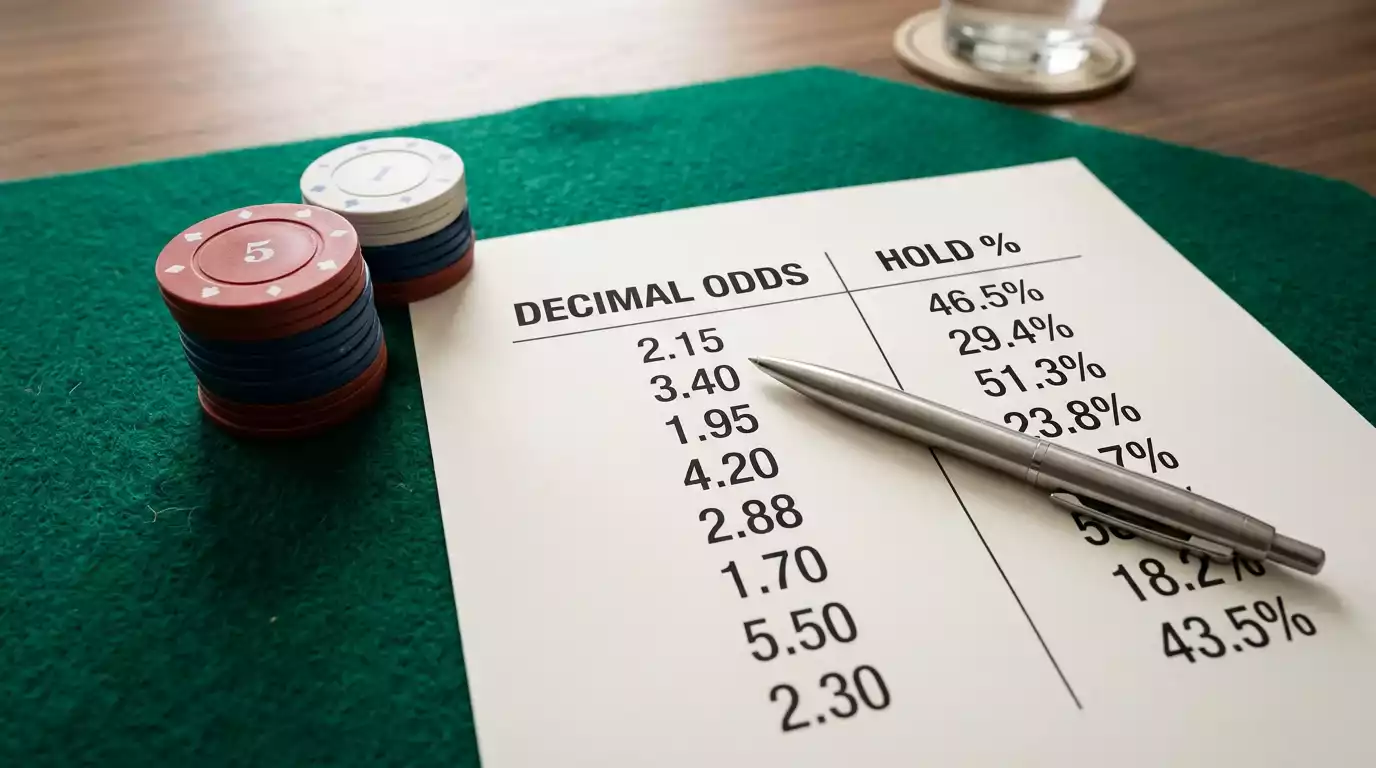
The formula itself is straightforward. Take a prop listed at decimal odds of 1.90 on the over. The implied probability is 1 divided by 1.90, which gives you 52.6%. Now add the implied probability of the under. Say that is also 1.90, so another 52.6%. The total is 105.2%, and that extra 5.2% above 100% is the overround, the bookmaker’s margin baked into the line. On single prop bets, sportsbooks typically hold between 4% and 6% of the handle. That is significantly less than the 20% to 30% they retain on parlays, which is one reason I focus the bulk of my activity on singles rather than accumulators.
To find expected value, you need your own estimate of the true probability. Suppose you believe the over on that 249.5 passing yards line hits 56% of the time based on your matchup analysis. Your EV calculation runs like this: (0.56 multiplied by the profit of 0.90) minus (0.44 multiplied by the stake of 1.00). That gives you 0.504 minus 0.44, or positive 0.064, a 6.4% edge. That is a bet worth making, regardless of whether it wins on the day.
The tricky part, obviously, is arriving at that 56% estimate with any confidence. I build mine from a combination of defensive rankings, recent target volumes, and pace-of-play data. None of those inputs are proprietary or hidden behind a paywall. They are publicly available metrics that most recreational bettors simply never bother to compile.
One thing I have learned the hard way: do not confuse a small edge with a guaranteed profit. A 3% edge means that over hundreds of bets, the maths is on your side. Over ten bets on a single Sunday, anything can happen. EV is a compass, not a crystal ball. Respect the variance, trust the process, and keep your sample sizes honest.
Line Shopping Across UK Sportsbooks
Here is a number that should change how you think about placing bets: 95% of all wagers in the UK are placed online, according to recent Gambling Commission data. That statistic matters because it means you have instant access to multiple sportsbook apps from your phone, and the difference in prop lines between them is often larger than you would expect.
On a spread or a total, UK bookmakers tend to cluster tightly around the same number. The market is deep, the action is heavy, and the lines converge fast. Props are different. A quarterback’s passing yards line might sit at 248.5 on one platform and 251.5 on another. That three-point gap is not a rounding error. It is a measurable difference in your win rate over time. On a receiving yards prop, half a point at the key number can shift your expected hit rate by two to three percentage points. Multiply that across a season of bets and you are looking at the difference between a losing year and a profitable one.
My own process is boringly mechanical. I keep three UK-licensed sportsbook accounts active during the NFL season. When I identify a prop I want to bet, I check the line on all three before placing anything. It takes about ninety seconds. The number of times I have found a full point or more of difference on a yards prop is genuinely surprising – it happens on at least a quarter of the bets I check, sometimes more on Thursday and Monday night games where single-game liquidity is lower.
The reason prop lines diverge more than game lines comes down to how they are priced. Sportsbooks rely on statistical models calibrated against different data sets. One platform might weight recent performance more heavily; another might lean on season-long averages. Neither is wrong, but the disagreement between them is your opportunity. When two books disagree on where a line should sit, at least one of them is offering you a better price than the true probability warrants.
A practical tip: line shop early in the week for the Sunday slate, but revisit late for Thursday and Monday games. Injury news drops throughout the week, and not every platform adjusts at the same speed. I have caught stale lines on more than one occasion simply by checking back an hour after a key injury designation was confirmed.
Why Unders Win More Often Than You Think
Ask a casual bettor which side they prefer on a player prop, and nine times out of ten, they will say the over. It feels right. You are rooting for the player to do more – more yards, more catches, more touchdowns. The over is exciting. The under is boring. And that psychological tilt is precisely why the under has been the more profitable side across multiple NFL seasons.
CBS Sports analysis across several recent seasons found that unders on NFL player props won approximately 60% of the time. That is not a marginal edge. It is a structural imbalance created by the betting public’s persistent preference for overs. Sportsbooks know this. They shade their lines accordingly, nudging the number slightly higher to attract over money while still maintaining their margin. The result is that the under frequently sits at a price that understates its true probability.
Why does this happen? Part of it is pure psychology. People bet on what they want to see. But there is a mechanical explanation too. NFL stat lines are bounded on the downside in ways they are not on the upside. A running back’s rushing yards can go as low as negative numbers, but there is a hard floor. Meanwhile, a blowout can pull a starter off the field by the third quarter, capping their production well below the line. Injuries mid-game, weather deterioration, game script shifts toward the run – all of these common scenarios push actual performance below the pre-game projection.
Matthew Davidow, a former executive at Huddle – one of the companies that supplies odds data to major sportsbooks – put the broader problem bluntly when he told the Washington Post that the current odds landscape is “terrible for society” because people’s chance to lose is far higher than it should be. That assessment applies with particular force to player props, where the vig is wider than on spreads and the public bias toward overs inflates the bookmaker’s advantage even further.
I do not bet unders on everything blindly. The edge is strongest on receiving yards and passing yards, where game script and defensive adjustments create the most downside volatility. Rushing yards unders are trickier because a single long run can blow past the line. My approach: target unders when the matchup data, game script, and weather all point in the same direction. When three independent factors converge on a lower-output scenario, the probability of the under hitting climbs well above what the line implies.
Discover profitable opportunities every week at the leading UK NFL prop betting site designed specifically for serious punters.
Early-Season Noise vs Late-Season Stability
Week 2 of the 2024 season, I was convinced I had found a gold mine. A wide receiver had exploded for 140 yards in the opener, and the bookmakers had barely moved his line for the following week. I loaded up on the over. He caught three passes for 31 yards. The problem was not the bet. It was the data. One game is not a trend. It is noise masquerading as a signal.
Early in the NFL season, prop lines are built on projections, preseason depth charts, and the previous year’s numbers. Sportsbooks do not have current-season data to calibrate against, and neither do you. The result is wider variance in outcomes and less reliable lines. A new offensive coordinator installing a different scheme, an unexpected target distribution in Week 1, a running back committee that was not apparent during the preseason – all of these create mismatches between the line and reality that are almost impossible to predict from the outside.
By Week 8, the picture clarifies. You have seven games of actual data on snap counts, target shares, route participation, and red zone usage. Sportsbook models tighten up. But here is the nuance most bettors miss: the lines become more accurate, but the remaining inefficiencies become more exploitable. When a bookmaker has been pricing a player’s passing yards at 265.5 all season and you notice that his last four games against zone-heavy defences averaged 289 yards, that discrepancy is real, not a one-week fluke. The edge is smaller in absolute terms but far more reliable.
My seasonal approach breaks into three phases. Weeks 1 through 4: reduce bet volume, increase caution, focus on players with stable roles from the previous season. Weeks 5 through 12: ramp up activity as the data stabilises, target matchup-specific edges, begin tracking line accuracy against actual outcomes. Weeks 13 through 18: this is where I do the most volume. The data is deep, the lines are tight, and the edges that remain are genuine – usually driven by fatigue, late-season injuries, or teams that have mentally checked out of the playoff race.
None of the top ten competitors in this space discuss seasonal adjustment. They treat the NFL season as a uniform block, which is a bit like analysing the stock market without distinguishing between January and December. The variance profile of a Week 2 player prop is fundamentally different from a Week 16 prop, and your strategy should reflect that.
Reading Game Script to Predict Prop Outcomes
The final score of a football game tells you almost nothing about what happened in the first three quarters. A 31-17 result could mean the winning team led wire to wire and ran the clock out, or it could mean the game was tied at 17 before a late surge. Those two scenarios produce radically different stat lines for every player on the field – and that is why game script projection is one of the most underrated tools in a prop bettor’s kit.
Start with the implied team total. If a game’s total is set at 48.5 and the spread is 6.5 points, the favoured team’s implied total is roughly 27.5 and the underdog’s is about 21. That 27.5 number tells you the market expects a high-scoring output from the favourite, which typically translates to more passing volume, more red zone opportunities, and higher individual ceilings for skill players. The underdog’s 21 points suggest a more constrained environment – fewer possessions, tighter clock management, and a higher likelihood of falling behind and abandoning the run game.
In-play betting now accounts for more than 60% of all online football wagers across Europe, according to industry statistics. That figure reflects how sensitive bettors have become to game flow. But the smart play is not reacting to game script in real time – it is anticipating it before kickoff. A team expected to trail will throw more, which inflates passing yards and receiving targets. A team expected to lead will run more in the second half, boosting rushing attempts for their lead back while suppressing their quarterback’s volume.
Garbage time deserves special attention. When a team trails by three or more scores in the fourth quarter, the defence softens. Linebackers play prevent coverage. Pass rushers dial back their effort. The result is inflated late-game stats that can push a quarterback’s passing yards over the line or gift a wide receiver an extra five catches. I have seen entire prop outcomes decided by a meaningless final drive that had zero impact on the result of the game.
John Murray, VP at SuperBook, once said he wants games to be “as boring as possible” – he wants to fall asleep in his office chair watching. That is the bookmaker’s perspective: low-variance, predictable outcomes protect their margin. As a bettor, your opportunity lives in the games that deviate from script. Blowouts, unexpected shootouts, defensive collapses – these are the scenarios where individual props diverge most from their pre-game lines, and where a well-researched position pays off.
A Step-by-Step Process for Selecting Props
Every Sunday morning during the season, I sit down with a cup of coffee at 9 AM and run through the same checklist. It takes about two hours for a full 13-game slate. The process is not glamorous, and it will not make you feel like a genius – but it is the reason I can look at my end-of-season numbers with something other than regret.
Step one: select the games worth your time. Not every matchup on a given week produces exploitable prop opportunities. I start by filtering for games with clear matchup advantages – a pass-heavy offence against a defence ranked in the bottom ten against the pass, or a workhorse running back facing a unit that allows the most rushing yards per attempt. Games between two evenly matched, defensively sound teams tend to produce tight, accurate lines. I skip those and focus where the asymmetry is greatest.
Step two: pull the matchup data. For each shortlisted game, I look at the specific defensive metrics that matter for the prop type I am considering. Passing yards props need pass defence DVOA, blitz rate, and yards allowed per attempt. Rushing yards props need rush defence ranking, run stuff rate, and front-seven snap counts. Receiving yards props need cornerback matchup data and target share trends. This is the homework phase – boring, essential, and the part most bettors skip entirely. If you want a framework for which defensive numbers matter most, there is a detailed breakdown in the defence rankings guide for prop betting.
Step three: check the lines across three sportsbooks. I record the line and the decimal odds for each prop I am interested in. If there is a meaningful discrepancy – half a point or more on a yards prop, or a noticeable odds difference on a touchdown prop – I note which book offers the best price.
Step four: calculate expected value. Using my matchup-derived probability estimate and the best available odds, I run the EV formula. If the number is positive and above my threshold of 3%, the bet goes on the shortlist. Below 3%, I pass. That threshold is not arbitrary. It accounts for the uncertainty in my probability estimates and ensures I am not betting on razor-thin edges that evaporate with a single variable change.
Step five: size the bet. I use a flat staking approach – 1% to 2% of my bankroll per prop, with a maximum of 3% on the strongest edges. No variable sizing based on confidence, no Kelly criterion adjustments. Flat staking is less theoretically optimal but far more psychologically sustainable. When you are staring at a three-bet losing streak on a Sunday afternoon, the last thing you want is to realise you over-sized the second one because you “felt good about it.”
Step six: place the bet and record it. Every bet goes into my tracking spreadsheet with the date, player, prop type, line, odds, book used, stake, and my estimated probability. After the game, I add the actual result. This log is not optional – it is the only way to evaluate whether your process is working over a meaningful sample. Without it, you are guessing about your own performance, which is no better than guessing about the props themselves.
Where Discipline Meets the Data
Nine seasons of covering NFL player prop markets have taught me that the edge in this space is not about having better information than the bookmaker. It is about having a better process than the majority of bettors on the other side of the line. The sportsbook’s model is good. It is not perfect. And the gap between good and perfect is where a disciplined, data-driven approach finds its margin.
Every strategy outlined here – EV calculation, line shopping, the under-bet bias, seasonal adjustment, game script reading – works best as part of a system. Cherry-picking one technique and ignoring the others is like training for a marathon by only practising sprints. The compound effect of applying all five consistently, week after week, is what turns a marginal edge into a sustainable one.
The bookmakers will keep getting sharper. The hold percentages will keep rising. The only response that makes sense is to meet that challenge with more rigour, not more volume. Bet less, bet smarter, and let the process do the heavy lifting.
How much edge do I need for a player prop to be worth betting?
I use a minimum threshold of 3% expected value before placing a prop bet. This accounts for estimation uncertainty in my probability models. A 1-2% edge might be mathematically positive, but the margin of error in your inputs can easily wipe it out. Consistently targeting 3% or higher provides a buffer that sustains profitability across a full season sample.
Do NFL prop lines become more accurate as the season progresses?
They do. Early-season lines rely heavily on projections and previous-year data, which introduces wider variance. By Week 8, sportsbooks have enough current-season information to tighten their models. The lines become harder to beat in absolute terms, but the edges that remain are more reliable because they are based on genuine matchup discrepancies rather than small-sample noise.
Why do sportsbooks shade over lines on popular player props?
Recreational bettors overwhelmingly prefer the over side because it feels more exciting to root for a big performance. Sportsbooks respond by nudging the line slightly higher to balance their exposure and attract more over money. This creates a structural advantage on the under side, which has historically won around 60% of NFL player prop bets across multiple seasons according to CBS Sports analysis.
Created by the ”nfl Best Player Prop Bets” editorial team.