Bankroll Management for NFL Prop Betting
 Available in US

I’ve met bettors with brilliant analytical minds who went broke because they couldn’t size a bet properly. I’ve also met bettors with average football knowledge who stayed profitable for years because they never risked more than they could afford to lose on a single prop. The second group wins over time. Bankroll management isn’t the exciting part of prop betting, but it’s the part that keeps you in the game long enough for your edge to compound.
UK bettors place roughly 290 million online sports bets per month according to Statista data. That volume includes a significant number of people who treat their sportsbook balance as a single lump sum rather than a managed bankroll. The difference between those two approaches, over an 18-week NFL season, is the difference between controlled risk and uncontrolled bleeding.
Unit Sizing for NFL Player Prop Wagers
A unit is simply the base amount you risk on a standard bet. It’s not a fixed pound figure – it’s a percentage of your total bankroll. The standard recommendation is 1-3% of your bankroll per bet, and for NFL player props specifically, I lean toward the lower end of that range because of the higher variance inherent in individual player markets.
If your total prop betting bankroll for the season is £1,000, one unit is £10 to £30. That means a single losing prop – and you will have many – costs you 1-3% of your bankroll. At that rate, a brutal ten-bet losing streak wipes out 10-30% of your bankroll rather than the whole thing. You survive, you reset, and you keep betting through the variance until your edge reasserts itself.
Sportsbooks hold 4 – 6% on single bets per BettorEdge analysis, which means even a skilled bettor with a genuine edge is grinding out small margins over large sample sizes. If your unit size is too large, a normal losing streak can eliminate your bankroll before you accumulate enough bets for the edge to materialise. I’ve seen this happen to sharp bettors who knew what they were doing analytically but couldn’t stomach the discipline of small, consistent stakes.
One rule I follow without exception: my unit size is fixed at the start of the season and recalculated only at predetermined checkpoints – after Weeks 6, 12, and 17. If my bankroll has grown, my unit size increases proportionally. If it’s shrunk, the unit size decreases. This removes the emotional temptation to increase stakes after a winning week or decrease them after a losing one. The unit tracks the bankroll, not my mood.
Flat Staking vs Kelly Criterion: Which Works for Props?
Flat staking is exactly what it sounds like: every bet is the same size, regardless of confidence level. One unit on a prop I love, one unit on a prop I merely like. It’s the simplest possible staking plan, and for most prop bettors, it’s the right one.
The Kelly criterion is the mathematically optimal alternative. It sizes each bet based on the perceived edge: a prop with a larger estimated edge gets a larger stake, while a marginal edge gets a smaller one. In theory, Kelly maximises the growth rate of your bankroll. In practice, it requires three things that most bettors can’t reliably provide: an accurate estimate of true probability, consistent discipline to follow the formula, and the emotional tolerance to place very large bets when the perceived edge is high.
I used Kelly for two seasons before switching to flat staking. The problem wasn’t the maths – it was my probability estimates. When I overestimated my edge on a prop, Kelly told me to bet big, and the losses were painful. When I underestimated, Kelly told me to bet small, and I missed upside. The Kelly criterion amplifies estimation errors in both directions, and in a market as volatile as NFL props, those estimation errors are frequent. Flat staking forgives imprecision. It doesn’t maximise growth, but it minimises damage, and in a high-variance environment, that’s more valuable.
If you insist on varying your stakes, fractional Kelly – betting a half or a quarter of what the full Kelly formula recommends – offers a compromise. It captures some of the edge-adjusted sizing benefit while dampening the impact of estimation error. I’ve seen experienced bettors use quarter-Kelly effectively, but only after years of tracking that gave them confidence in the accuracy of their probability estimates.
Weekly Session Limits and Seasonal Bankroll Review
Dr. Joshua Grubbs, a clinical psychologist at the University of New Mexico, has observed that sports gambling itself isn’t inherently risky – but sports gamblers are. That distinction matters for bankroll management because the system you build has to account for human behaviour, not just mathematical theory.
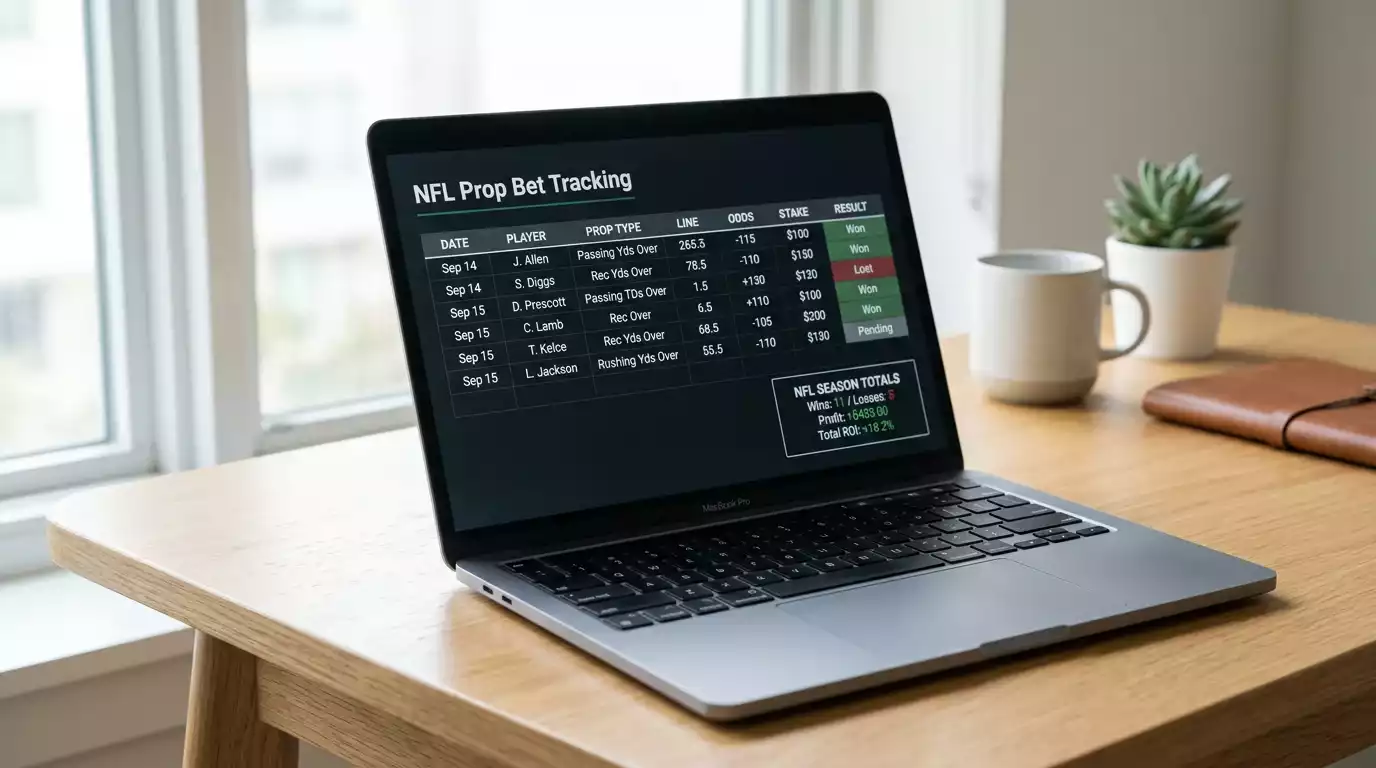
I set weekly session limits that cap the number of prop bets I place per slate. My rule: no more than eight props on a Sunday, two on Thursday Night Football, and two on Monday Night Football. That cap exists because my analytical quality degrades after the eighth or ninth evaluation. The first five props of the week get my best research. The twelfth prop of the week gets a hurried glance at the matchup and a gut feeling. Gut feelings don’t have positive expected value.
At the end of each month during the season, I review my bankroll against a projected trajectory. If I’m ahead of projection, I maintain my unit size and resist the urge to increase it mid-season. If I’m behind, I check whether the losses are within normal variance – a losing month can happen even with a genuine edge – or whether my process has degraded. Variance means I keep going. Process degradation means I pause, review my tracking data, and identify the analytical mistakes before placing another bet.
The seasonal bankroll review after Week 17 is the most important check. I examine my full-season results across every prop type, every position, and every sportsbook. The patterns that emerge – maybe I consistently overvalue running back rushing props, or my quarterback interception bets have a negative ROI despite feeling promising – inform the adjustments I make for the following season. Bankroll management isn’t just about this week’s bets. It’s about building a sustainable process across years. For a practical view of the tools that support responsible betting within this framework, the responsible gambling tools guide covers deposit limits, session timers, and self-exclusion options.
What percentage of my bankroll should a single NFL prop bet represent?
Between 1% and 3% per bet for most bettors. Player props carry higher variance than spread bets, so staying at the lower end of that range provides more protection against losing streaks. If your total NFL prop bankroll is one thousand pounds, each bet should risk ten to thirty pounds.
Should I adjust my unit size based on how confident I am in a prop?
Only if you have a reliable method for estimating your actual edge and have tracked its accuracy over a significant sample. Most bettors overestimate their confidence, which makes variable staking counterproductive. Flat staking — the same unit on every bet — is safer and simpler for the majority of prop bettors. If you do vary stakes, use fractional Kelly to limit the downside of estimation error.
Created by the ”nfl Best Player Prop Bets” editorial team.