NFL Prop Betting Mistakes and Risk Management
 Available in US
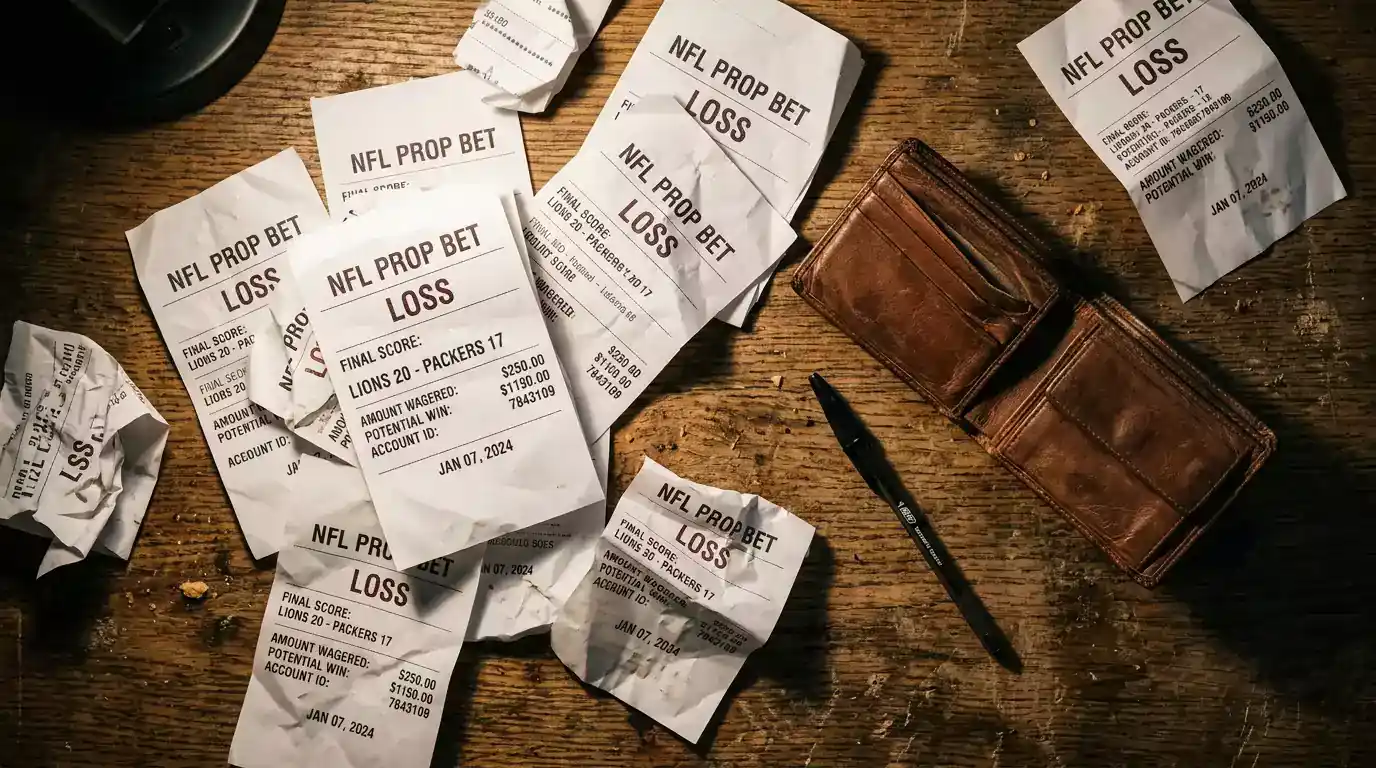
I’ve been analysing NFL player props for nine years, and I can trace my costliest losses not to bad luck but to identifiable mistakes – patterns of thinking I repeated until the damage forced me to change. The errors I’m about to describe aren’t theoretical. Every one of them has cost me money, and every one of them costs other bettors money right now. The average sportsbook hold percentage has risen above 9% per Doc’s Sports analysis. The house edge is already working against you; compounding it with avoidable mistakes turns a challenging endeavour into a losing one.
Chasing losses is a common error, which is why utilizing responsible gambling tools for NFL prop bettors is crucial for long-term success.
Analytical Errors in NFL Prop Bet Selections
Recency bias is the most expensive analytical mistake in prop betting, and it’s the hardest to correct because it feels like good analysis. A running back breaks off a 120-yard game in Week 8, and suddenly his Week 9 rushing prop looks irresistible on the over. The problem: one game is noise. His season average is 72 yards. The defence he faced in Week 8 was ranked 30th against the run. The defence he faces in Week 9 is ranked 4th. Recency bias tells you to ride the hot hand. Rigorous analysis tells you to check the matchup.
Small-sample decisions are a close cousin. In Weeks 1 through 4, every player’s season stats are based on three or four games. A receiver averaging 95 yards per game through three weeks might be genuinely elite – or he might have caught one blown coverage for a 60-yard touchdown in each game that inflated his numbers. I don’t trust individual player averages until at least six games of current-season data exist. Before that, I weight the previous season’s performance more heavily and discount the current-season numbers as insufficient.
Narrative traps are the subtlest of the three. The media creates stories around players – revenge games, milestone chases, primetime spotlights – and bettors absorb those narratives as analytical inputs. A quarterback “due for a big game” against his former team isn’t a statistical thesis. It’s a story. Stories don’t move stat lines. Matchups, game script, and volume do. Unders on player props win roughly 60% of the time per CBS Sports data, partly because the public bets overs on narrative-driven selections that sound good but lack structural support.
Structural Errors: Ignoring Vig, Over-Parlaying, and Chasing
The single most common structural mistake is ignoring the vig. Every prop has a built-in house edge, and that edge varies by market. A popular quarterback passing yards prop might carry a 5% margin. A niche tight end reception count prop might carry 8%. If you don’t calculate the overround on every prop you bet, you’re paying a tax you’ve never quantified – and you can’t manage what you can’t measure.
Over-parlaying is the structural mistake the sportsbook most wants you to make. In Nevada, sportsbooks have held 30.97% on parlays since 1984, compared to 5.6% on other bets, per BettorEdge data. That historical gap isn’t a fluke – it’s the mathematics of compounding margin across multiple legs. Every leg you add to a parlay increases the effective hold. A three-leg same-game parlay carries roughly 15-20% effective vig, and a five-leg parlay can approach 30%. The payout looks impressive. The expected loss is the real story.
Chasing losses is the structural mistake that ends bankrolls. You lose three props in the early window, and by the late afternoon games you’re doubling your stakes to get back to even. The mathematics of chasing are unforgiving: doubling your stakes after a loss doesn’t double your probability of winning. It doubles your exposure to the same house edge that produced the original loss. The spiral is predictable and devastating. If you recognise this pattern in your own behaviour, the solution isn’t better analysis – it’s a hard rule. I set a daily loss limit before the first game kicks off, and when I hit it, I stop. No exceptions.
Learn how to avoid costly errors and bet smarter with the best NFL player prop bets resource available online today.
Behavioural Errors: Emotional Betting and Loss Chasing
Emotional betting is broader than loss chasing. It includes betting on your favourite team’s players because you watch every game and feel like you “know” them, betting during games you’re watching live because the excitement overwhelms your discipline, and betting more aggressively after a winning streak because you feel invincible.
The favourite-team trap is particularly insidious. You do know those players better than most, which gives you an analytical advantage. But you’re also emotionally invested in their success, which distorts your probability estimates. I’ve learned to flag my own team’s props with an internal warning: “Am I betting this because the analysis supports it, or because I want my guy to have a big game?” If the honest answer is the latter, I skip it.
Winning streaks produce a cognitive distortion that psychologists call the hot-hand fallacy. After four winning props in a row, the temptation to increase stake size – “I’m on a roll” – is powerful. But your edge doesn’t increase because of recent results. Your probability estimates are the same on the fifth bet as they were on the first. The variance that produced four wins in a row can just as easily produce four losses in the next batch. Flat staking eliminates this temptation by removing the decision point entirely: every bet is the same size, regardless of what happened before.
The meta-mistake that connects all ten errors is failing to track. Without a record of every bet – the prop, the line, the odds, the result, and the reasoning – you can’t identify which mistakes you’re making. You’ll know you’re losing money, but you won’t know why. A tracking spreadsheet turns vague frustration into specific, fixable problems. Every one of the ten mistakes I’ve described in this article is visible in a well-maintained betting log, and visibility is the first step toward correction. For a practical system on building that log, the bankroll management guide covers unit sizing, staking plans, and seasonal review processes.
What is the single most expensive mistake NFL prop bettors make?
Ignoring the compounding vig on parlays. A single prop bet carries a 4-6% house edge. A three-leg parlay compounds that to roughly 15-20%. A five-leg parlay can approach 30%. Bettors who routinely build multi-leg parlays without understanding the effective margin are paying the highest possible price for every wager — and the sportsbook’s revenue data confirms it.
How does recency bias specifically affect player prop selections?
Recency bias causes bettors to overweight a player’s most recent game when evaluating his next prop. A strong performance inflates expectations for the following week, even when the upcoming matchup is unfavourable. The correction is to check the season-long baseline and the specific defensive matchup rather than anchoring to the last game’s stat line.
Prepared by the nfl Best Player Prop Bets editorial staff.