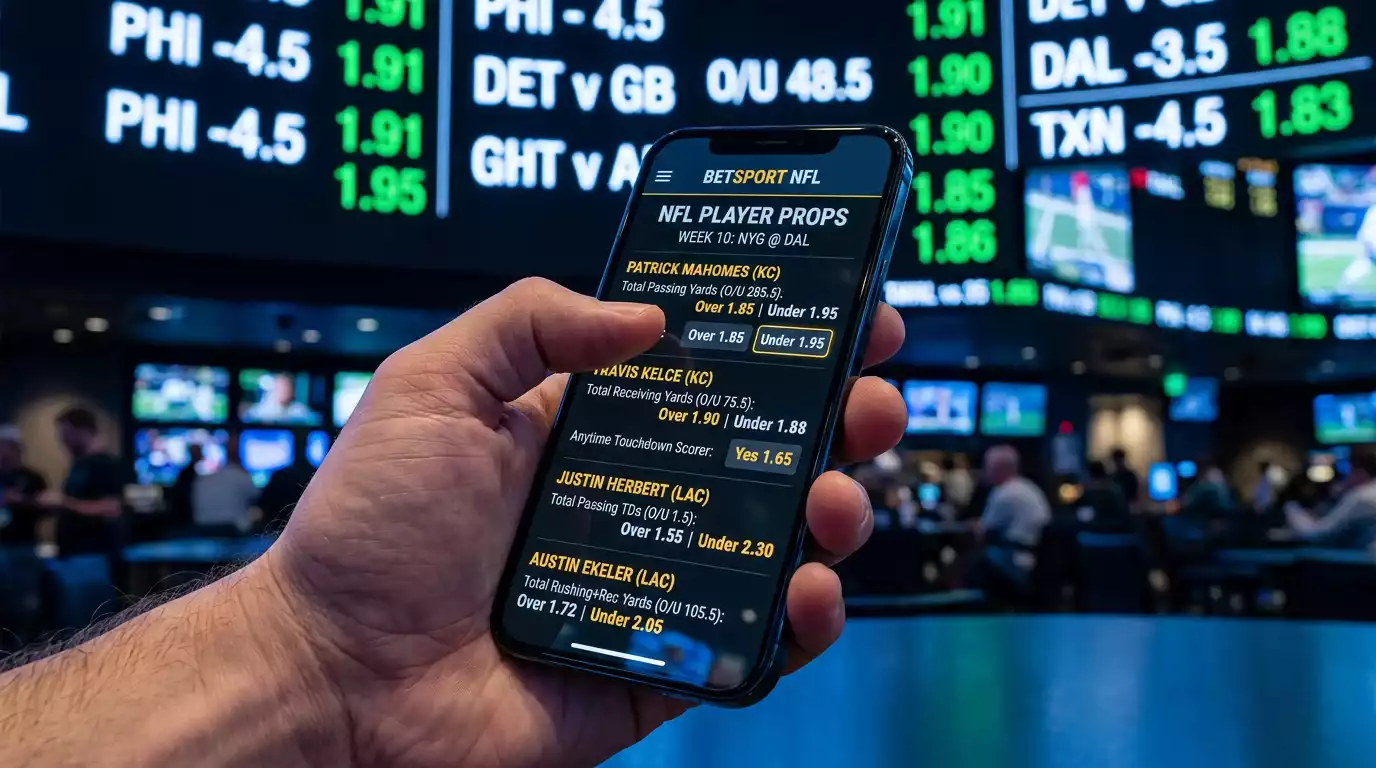
Anytime Touchdown Scorer Prop Bets
 Available in US
There is a reason the anytime touchdown scorer market sits at the top of every sportsbook’s prop board. It is the simplest bet in the NFL prop universe: pick a player, and if he scores a touchdown at any point during the game, you win. No yardage thresholds, no statistical calculations, no over/under decisions. Just a name and a result. BetMGM and ESPN data confirm what any regular prop bettor already knows. Anytime TD is the most popular player prop market by handle, outpacing receiving yards over/under and first touchdown scorer in total action.
That simplicity is both the appeal and the trap. Because ATTD bets feel intuitive, they attract enormous recreational volume, which gives sportsbooks the cover to price them with wider margins than more complex prop types. The market is deep enough that the lines are not wildly inefficient, but the combination of high public interest and relatively wide vig means that finding genuine value requires more discipline than most bettors bring to the table.
I bet ATTD markets more than any other prop type. Not because they are easy (they are not) but because the data inputs are clear, the analytical framework is straightforward, and the edges, when they exist, are repeatable. This guide covers the mechanics, the data that drives the odds, and the positional breakdown that shapes my weekly ATTD selections throughout the NFL season.
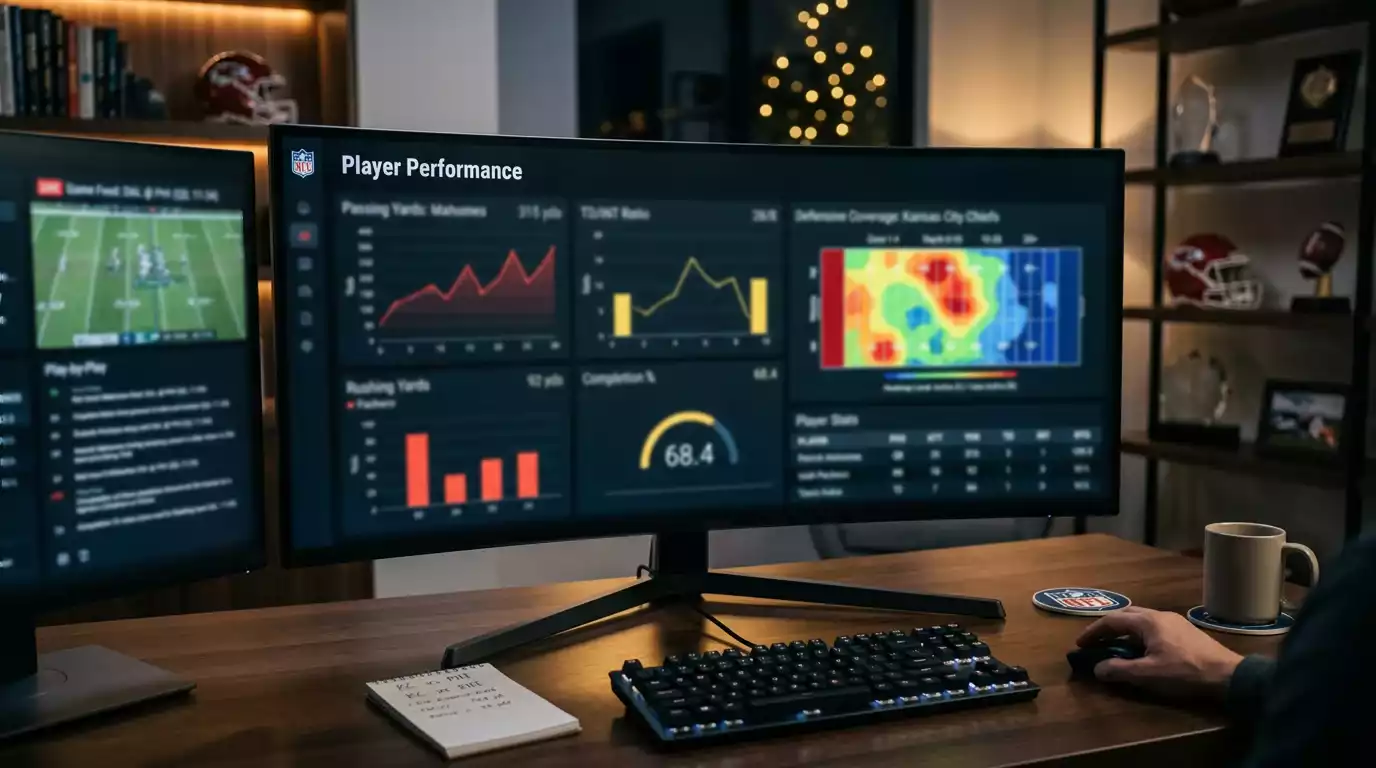
Identifying high-value red zone targets requires access to reliable NFL prop bets data sources and advanced analytics.
- Anytime Touchdown Scorer Betting Structure and Value
- What Drives Anytime TD Odds: Red Zone Data and Usage
- First Touchdown Scorer vs Anytime: Which Bet Offers Better Value?
- ATTD Value by Position: Running Backs, Receivers, and Tight Ends
- Avoiding Common ATTD Betting Mistakes
- Scoring Is the Simplest Outcome, but Betting It Well Is Not
Anytime Touchdown Scorer Betting Structure and Value
Player props accounted for as much as 60% of all betting activity on some platforms during Super Bowl LX, according to Sportsepreneur data. A significant slice of that action was directed at the anytime touchdown scorer market, the single largest prop category for the biggest betting event of the year. Understanding how these bets are structured is the first step toward betting them profitably rather than just enthusiastically.
The mechanics are straightforward. You select a player from either team in a given NFL match. If that player scores a touchdown by any method (rushing, receiving, fumble recovery, interception return) during regulation time, your bet wins. Overtime touchdowns typically count as well, though this varies by platform, so checking the settlement rules on your specific UK sportsbook is worth the thirty seconds it takes.
Odds are displayed as a single price per player. A workhorse running back who scores frequently might be listed at 1.50 in decimal odds, short enough to reflect the market’s expectation that he has roughly a 60% to 65% chance of scoring. A third-string wide receiver with minimal red zone involvement might sit at 7.00 or higher, reflecting a probability below 15%. The range is wide because touchdown equity varies enormously by role, position, and game context.
One structural detail that UK bettors should note: the ATTD market is typically priced with a wider overround than yards-based props. On a standard over/under for passing yards, the combined implied probability might total 105%. On a multi-player ATTD market, where the sportsbook is offering odds on twenty or more players in the same game, the cumulative overround across all selections can exceed 130%. That extra margin is the cost of the market’s complexity. The bookmaker is pricing dozens of interconnected outcomes from the same event, and the protection they build into each line adds up quickly.
The ATTD market differs from the first touchdown scorer market in one critical respect: timing does not matter. A first TD bet requires your player to score the opening touchdown of the game, which introduces massive variance. The first scoring play is unpredictable by nature, often determined by a single drive’s worth of play-calling decisions. Anytime TD removes that randomness, asking only whether the player scores at some point across sixty minutes. The lower variance makes ATTD a more analytically tractable market, which is why I focus the bulk of my touchdown prop activity here rather than on first scorer bets.
What Drives Anytime TD Odds: Red Zone Data and Usage
The Kansas City Chiefs are the most popular NFL team in the UK, commanding 9.5% of all NFL-related search traffic with roughly 50,000 monthly queries according to Hyperset Group data. That popularity has a direct impact on ATTD pricing. When Travis Kelce or another high-profile Chiefs player is listed on the ATTD board, the public money is heavier than on an equivalent player from a less popular team. That extra volume nudges the odds shorter, sometimes below fair value, creating a situation where the popular pick is overpriced from an expected value perspective.
Red zone data is the engine that drives ATTD analysis. The two metrics I track most closely are red zone targets (for receivers and tight ends) and goal-line carries (for running backs). A player who sees five red zone targets per game has fundamentally different touchdown equity from one who sees two, even if their overall target shares are similar. The red zone is where touchdowns happen, and usage inside the 20-yard line is the single strongest predictor of ATTD outcomes.
Goal-line carries (rushing attempts inside the 5-yard line) are the equivalent metric for running backs. A back who handles 80% of his team’s goal-line work will score touchdowns with high frequency regardless of his overall yardage. The market generally prices this in for the most prominent goal-line backs, but there are edges in the middle tier: backup running backs who handle a disproportionate share of goal-line work without receiving the public recognition that moves the odds.
Target share inside the 10-yard line adds another layer. Wide receivers who run fade routes and back-shoulder throws in the end zone accumulate touchdown equity differently from slot receivers who work the middle of the field. The fade-route specialist may see fewer overall targets but a higher percentage of end zone looks, which translates into ATTD value that the headline target share number does not capture.
Red zone touchdown rate, the percentage of red zone opportunities that actually convert into touchdowns, varies by team and by week. A team with a high red zone TD rate is converting opportunities efficiently, which benefits every skill player on the offence. A team that settles for field goals suppresses ATTD outcomes across the board. I check the team-level red zone conversion rate before evaluating any individual player’s ATTD odds because it sets the baseline for how many scoring opportunities are likely to exist in the game.
First Touchdown Scorer vs Anytime: Which Bet Offers Better Value?
Craig Mucklow, VP of Trading at Caesars Sports, captured the razor-thin margins of touchdown betting perfectly after Super Bowl LX. He described his team’s reaction when a late, meaningless touchdown nearly swung the outcome of thousands of first scorer bets, a “monumental swing for bettors” that had his team on edge. That volatility is the defining characteristic of first TD props, and it is the reason I favour anytime over first scorer in nearly every scenario.
The mathematical comparison is stark. A running back priced at 1.70 for anytime TD might be listed at 8.00 or 9.00 for first TD. The first scorer price reflects the fact that this specific player needs to score the very first touchdown of the game, an outcome that depends on which team receives the opening kickoff, how the first drive unfolds, and whether the scoring comes via a passing play or a run. Those variables are largely unpredictable. The first drive of an NFL game is among the most scripted in the sport, and defensive coordinators design specific packages to counter those scripted plays, creating an inherently chaotic opening sequence.
There are situations where first TD offers value. When a team has a clearly scripted opening-drive tendency – a heavy run team that feeds its lead back on the first possession, or an offence known for opening with a deep shot to its top receiver – the first scorer market can be mispriced because the sportsbook’s model does not weight opening-drive tendencies as heavily as the situation warrants. I exploit this maybe three or four times per season, always with small stakes, treating it as a high-variance supplement rather than a core strategy.
For consistent, process-driven prop betting, anytime TD is the superior product. The variance is lower, the analytical inputs are more reliable, and the outcomes are less dependent on the random sequencing of early-game events. First scorer is a coin flip wrapped in narrative. Anytime TD is a probability bet – and probability bets are where systematic bettors make their money.
There is one hybrid approach I use occasionally: when my ATTD analysis identifies a player with genuine value, and that same player happens to be the most likely first scorer candidate based on opening-drive tendencies, I will place a small first TD bet alongside the anytime TD bet. The ATTD is the anchor – the expected-value play. The first TD is the satellite – a high-variance add-on that I size at no more than a quarter of my ATTD stake. This approach captures the upside of first scorer odds without overcommitting to the most unpredictable market on the board.
ATTD Value by Position: Running Backs, Receivers, and Tight Ends
Running backs are the workhorses of the ATTD market. A lead back with a dominant share of goal-line carries will score a rushing touchdown in roughly 55% to 65% of games, making him a frequent short-odds selection. The edge here is not in the lead backs themselves (the market prices them accurately) but in the committee situations where a secondary back handles more goal-line work than his overall usage suggests. These “vulture” backs steal touchdowns from the lead runner on the most valuable carries of the drive, and their ATTD odds often do not reflect this specific role.
The UK betting market for NFL, part of a remote GGY sector that reached 2.4 billion pounds in the latest Gambling Commission reporting period, is deep enough that these positional nuances are priced into the most popular markets. But the efficiency breaks down on less prominent players: the backup running back, the blocking tight end who occasionally leaks into the end zone, the gadget player used in red zone packages. These are the players where my ATTD analysis finds the most consistent value.
Wide receivers present a different ATTD profile entirely. Their touchdowns come through the air, which introduces the quarterback as a variable. A receiver who runs excellent routes and gets open in the end zone is worthless for ATTD purposes if his quarterback cannot deliver the ball accurately under red zone pressure. I evaluate the quarterback-receiver connection specifically inside the red zone (completion percentage on end zone targets, not overall) before considering a receiver’s ATTD odds.
Target share inside the 10 is the critical filter. A receiver with a 25% team target share overall but a 40% share inside the 10-yard line has significantly higher touchdown equity than his headline number suggests. The reverse is also true: a high-volume receiver whose targets dry up near the goal line, perhaps because his team switches to heavy run formations in the red zone – has less ATTD value than his overall production implies.
Tight ends occupy a unique position in the ATTD market. The best receiving tight ends are red zone weapons by design – they exploit mismatches against linebackers and safeties in the end zone, where the compressed field limits the defensive back’s ability to recover. A tight end with consistent red zone targets and a quarterback who trusts him in scoring situations is one of the most reliable ATTD selections in the market. The prototype is well established: a 6’5″ pass-catching tight end who runs seam routes and corner routes in the end zone creates problems that most defensive personnel packages cannot solve. When the matchup projects a slow linebacker covering a fast tight end inside the 10, that is where I look for ATTD value.
The mistake most bettors make with tight end ATTD props is treating the position as a monolith. Blocking-first tight ends who rarely run routes have almost no touchdown equity through the air. Their occasional scores come on broken plays or trick formations, and those events are too random to model. The ATTD value concentrates in the top receiving tight ends – the players who are genuine passing-game weapons rather than sixth offensive linemen who occasionally sneak into the flat. The running back prop betting guide explores the positional analysis further for those who want the full breakdown of rushing-specific factors and workload metrics.
Stay ahead of the bookmakers by following the top NFL props guide for UK bettors throughout the entire regular season.
Avoiding Common ATTD Betting Mistakes
The most common ATTD mistake is chasing short-odds favourites week after week. A running back priced at 1.45 to score anytime needs to find the end zone in roughly 69% of games just to break even. Over a full season, very few players sustain that rate. Even the most prolific scorers have scoreless games – bad matchups, early injuries, game scripts that abandon the run. Betting short odds on popular names feels safe, but the maths erodes your bankroll slowly and steadily through accumulated negative expected value.
Ignoring vulture backs is the second error. In many NFL offences, the lead running back does the hard work of moving the chains on first and second down, but a different back, often a larger, short-yardage specialist, enters the game inside the 5-yard line. The lead back’s ATTD odds are priced assuming he handles goal-line work. When a vulture back steals those carries, the lead back’s touchdown equity drops significantly. Checking the goal-line snap data before betting is essential; the raw carry count does not tell you who gets the most valuable touches.
Overweighting recent touchdowns is a cognitive trap specific to this market. A player who scored in three consecutive weeks feels like a hot hand worth backing. In reality, touchdown scoring at the individual level has very low week-to-week correlation. A three-game scoring streak is more likely the product of favourable matchups and game script than a sustainable shift in the player’s touchdown production. My approach: I do not adjust my ATTD evaluation based on recent scoring streaks. I use the same red zone data, target share, and matchup analysis regardless of whether the player scored last week or went scoreless.
Game script awareness matters more in ATTD markets than most bettors realise. In a blowout, the winning team runs the clock with its backup running back in the fourth quarter. The starter, the player you bet on, is on the sideline in a cap and gown while a reserve running back punches in a garbage-time touchdown. Conversely, a team trailing badly throws constantly in the second half, which can create unexpected receiving touchdowns for players who would not normally see end zone targets. Projecting the game script before kickoff and considering how it affects each player’s ATTD equity is the final layer of analysis that separates methodical bettors from hopeful ones.
Scoring Is the Simplest Outcome, but Betting It Well Is Not
The anytime touchdown scorer market thrives on accessibility. It is the prop bet that requires no specialised knowledge to understand, no conversion formulas, no complex matchup analysis. You pick a player, he scores, you win. That simplicity attracts the widest audience in the prop universe – and the widest audience creates the widest gap between public perception and analytical reality.
Every edge I have described here – red zone target analysis, goal-line carry data, positional breakdown, game script projection, vulture back identification – is publicly available information. None of it is hidden behind a paywall or restricted to industry insiders. The advantage comes from doing the work that most bettors skip, consistently, every week, across an entire season. The ATTD market rewards patience and process. It punishes impulse and popularity. And that dynamic, in a market driven overwhelmingly by recreational money, is what makes it one of the most fertile grounds for disciplined prop bettors.
What is the difference between anytime and first touchdown scorer bets?
An anytime touchdown scorer bet wins if the selected player scores at any point during the game. A first touchdown scorer bet wins only if the player scores the very first touchdown. Anytime bets carry shorter odds but far lower variance, while first scorer bets offer higher payouts with significantly more unpredictability. The first scoring play depends heavily on opening-drive sequencing and game flow, making it harder to predict consistently.
Do running backs or wide receivers offer better anytime TD value?
Running backs generally offer more consistent touchdown equity because their scoring comes through volume – goal-line carries are more predictable than end zone targets. Wide receivers offer higher potential value on specific matchups where they dominate red zone targets, but their touchdowns depend on the quarterback connection, making outcomes more variable. For systematic ATTD betting, running back analysis tends to produce more reliable results across a season sample.
How do NFL London games affect touchdown scorer odds?
London games introduce variables that can shift ATTD outcomes. Travel fatigue may suppress overall offensive efficiency, reducing scoring opportunities. Unfamiliar venue conditions and disrupted preparation routines add variance. Sportsbooks do not always fully adjust ATTD odds for these factors, which can create value on unders for total touchdowns and on players whose roles are most resistant to environmental disruption, such as goal-line running backs with high-volume short-yardage roles.
Can a defensive or special teams player score an anytime touchdown?
Yes. Most sportsbooks settle ATTD bets on any touchdown scored during the game, including interception returns, fumble recoveries, punt returns, and kick returns. However, defensive and special teams touchdowns are extremely low-frequency events, and the odds reflect that – typically 10.00 or higher in decimal format. These are high-variance selections that fall outside the scope of systematic ATTD analysis and are better treated as entertainment bets rather than value plays.
Created by the ”nfl Best Player Prop Bets” editorial team.