Prop Bet Hold Percentage and Sportsbook Margins
 Available in US
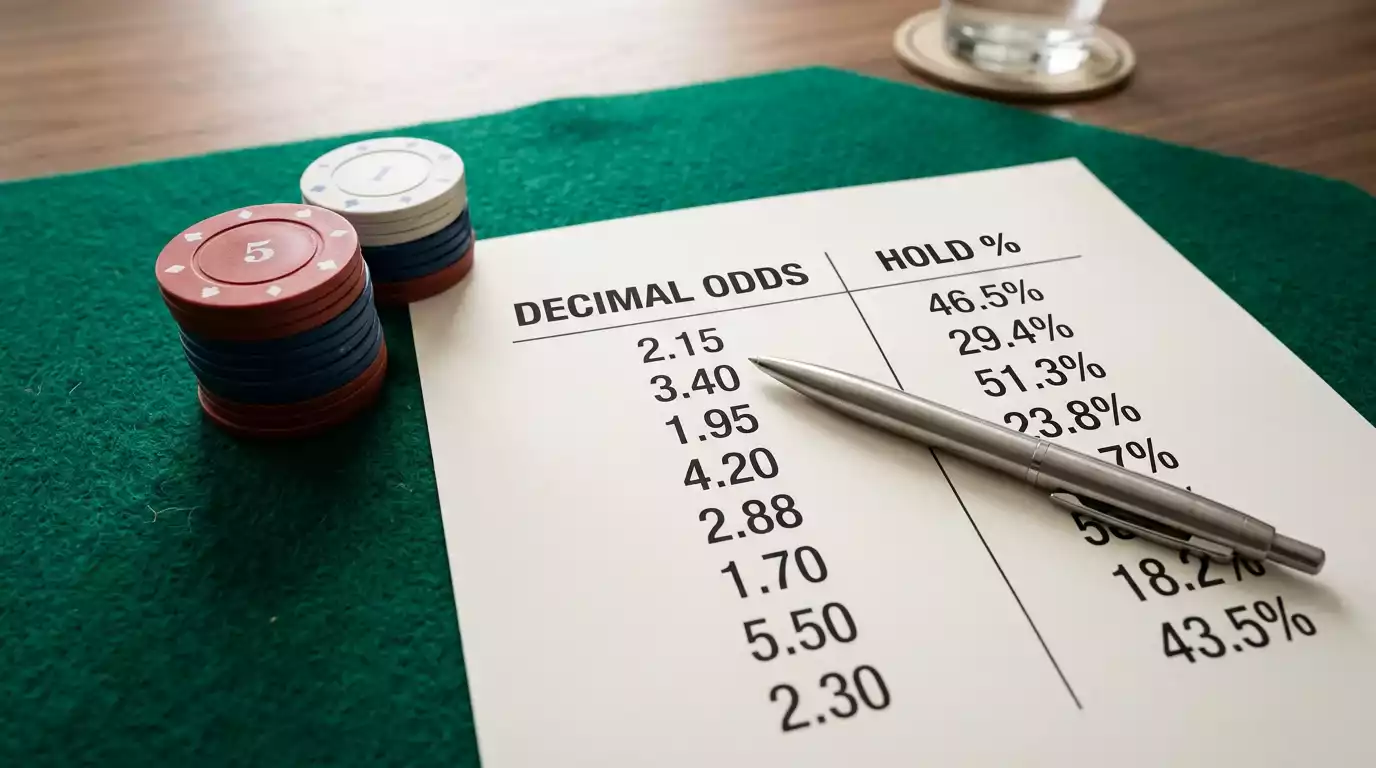
The number that determines whether you can win long-term at NFL prop betting isn’t your win rate, your football knowledge, or your discipline. It’s the hold percentage – the slice of every pound wagered that the sportsbook keeps before you even place your bet. And on player props, that slice is bigger than most bettors realise. Sportsbooks retain 4 – 6% on straight bets like point spreads, but on parlays the hold climbs to 20 – 30%, according to analysis from BettorEdge and Covers. That gap is the single most important structural fact in sports betting, and almost nobody talks about it.
I’ve had conversations with experienced bettors – people who’ve been wagering for years – who couldn’t tell me within ten percentage points what the sportsbook takes from a typical prop. That blind spot costs real money over time, and closing it is the first step toward betting with open eyes rather than crossed fingers.
Bookmaker Hold Percentage Impact on Prop Bets
Hold percentage is the sportsbook’s margin – the mathematical edge built into every line. Think of it as the price of admission. If the hold on a prop market is 5%, then for every £100 wagered across all bettors, the sportsbook expects to keep £5 and return £95. Your job is to overcome that 5% tax through superior selection.
The average hold percentage across US sportsbooks has risen from 6.7% in 2018 to above 9% in 2024 – 2025, per Doc’s Sports analysis. That trend isn’t accidental. Sportsbooks have invested heavily in pricing models, and the growing popularity of parlays – where the hold is dramatically higher – has pulled the blended average upward. For UK bettors, the same dynamic applies: your platform’s margin on props is almost certainly higher today than it was five years ago.
What makes hold percentage particularly relevant for props is that it varies by market. The hold on a quarterback passing yards prop might be 5%, while the hold on a niche market like a tight end’s reception count might be 8% or higher. The sportsbook widens the margin on lower-liquidity markets because less public money flows through them, reducing the natural balancing mechanism that keeps mainstream markets competitive. When you bet on obscure props, you’re paying a premium – and that premium is invisible unless you calculate it yourself.
Why Props Carry a Higher Vig Than Spreads
Point spreads are the most efficient market in sports betting. They attract the most volume, the most sharp money, and the most sophisticated modelling from the sportsbook. That competition drives the vig down to its floor – typically around 4.5% for a standard -110/-110 spread.
Player props lack that competitive pressure. The models are less precise because individual performance is inherently more variable than team outcomes. The betting public is less informed – many prop bettors are casual participants chasing name recognition rather than edge. And the sharp money that polices spread markets is spread thinner across hundreds of prop lines per game.
In Nevada, sportsbooks have held 30.97% on parlays since 1984, compared to 5.6% on other bet types, according to BettorEdge data. That historical record reveals a structural reality: the more legs you add, the more the house wins. Same-game parlays built from player props combine both disadvantages – the wider vig on individual prop legs compounded across multiple selections.
This doesn’t mean props are a bad bet. It means the bar for profitable prop betting is higher than for spread betting. You need a bigger edge per bet to overcome the larger vig. I approach it as a filter: if my analysis suggests a player prop has a 3% edge, that might not be enough to overcome a 6% hold. I need the edge to exceed the hold by a meaningful margin before committing money – a discipline that keeps me out of marginal spots and focused on the bets where my advantage is clearest.
How to Calculate the Vig on Any Prop Line
Nik Bonaddio, the former Head of Product at FanDuel, estimated that perhaps 5% of people understand the house edge on parlays. The good news is that calculating it for any individual prop is straightforward once you know the formula.
Take a prop priced at 1.91 for the over and 1.91 for the under. Convert each to implied probability: 1 divided by 1.91 equals 52.36%. Both sides sum to 104.72%. The amount above 100% is the overround – 4.72% in this case. That’s the vig. The sportsbook’s true implied probability for each side is 52.36 divided by 104.72, which gives you 50.0%. The extra 2.36 percentage points per side is the house’s cut.
Now compare that to a prop priced at 1.83 for the over and 2.00 for the under. The over implies 54.6%, the under implies 50.0%, summing to 104.6%. Similar vig, but the line is skewed – the sportsbook is telling you the over is the more likely outcome while still charging roughly the same margin.
In practice, I calculate the overround for every prop I consider betting. If the overround exceeds 7%, I know the sportsbook is charging a premium for that market, and my edge needs to be correspondingly larger. For a deeper look at how this dynamic intensifies when you combine multiple props into a single bet, the same-game parlay analysis walks through the compounding effect step by step.
The goal isn’t to avoid vig – that’s impossible. The goal is to know exactly what you’re paying and ensure your analytical edge exceeds the cost. Every profitable prop bettor I’ve spoken to over nine years shares that awareness. The ones who lose over time are almost universally the ones who never calculate it.
How does hold percentage differ between a straight prop bet and a three-leg parlay?
A single prop bet typically carries a hold of 4-6%. A three-leg parlay compounds that hold across each leg, resulting in an effective hold of roughly 15-20% depending on the individual prices. The sportsbook’s margin grows geometrically with each added leg, which is why parlays are far more profitable for the house than straight bets.
How can I tell if one sportsbook offers lower vig than another on the same prop?
Calculate the overround for the same prop on each platform. Convert the over and under prices to implied probabilities, sum them, and compare the total. The platform with the lower overround is charging less vig. Even a 1-2% difference in overround translates to meaningful savings across hundreds of bets over a season.
Published by the nfl Best Player Prop Bets team.