NFL Prop Correlations for Same-Game Markets
 Available in US
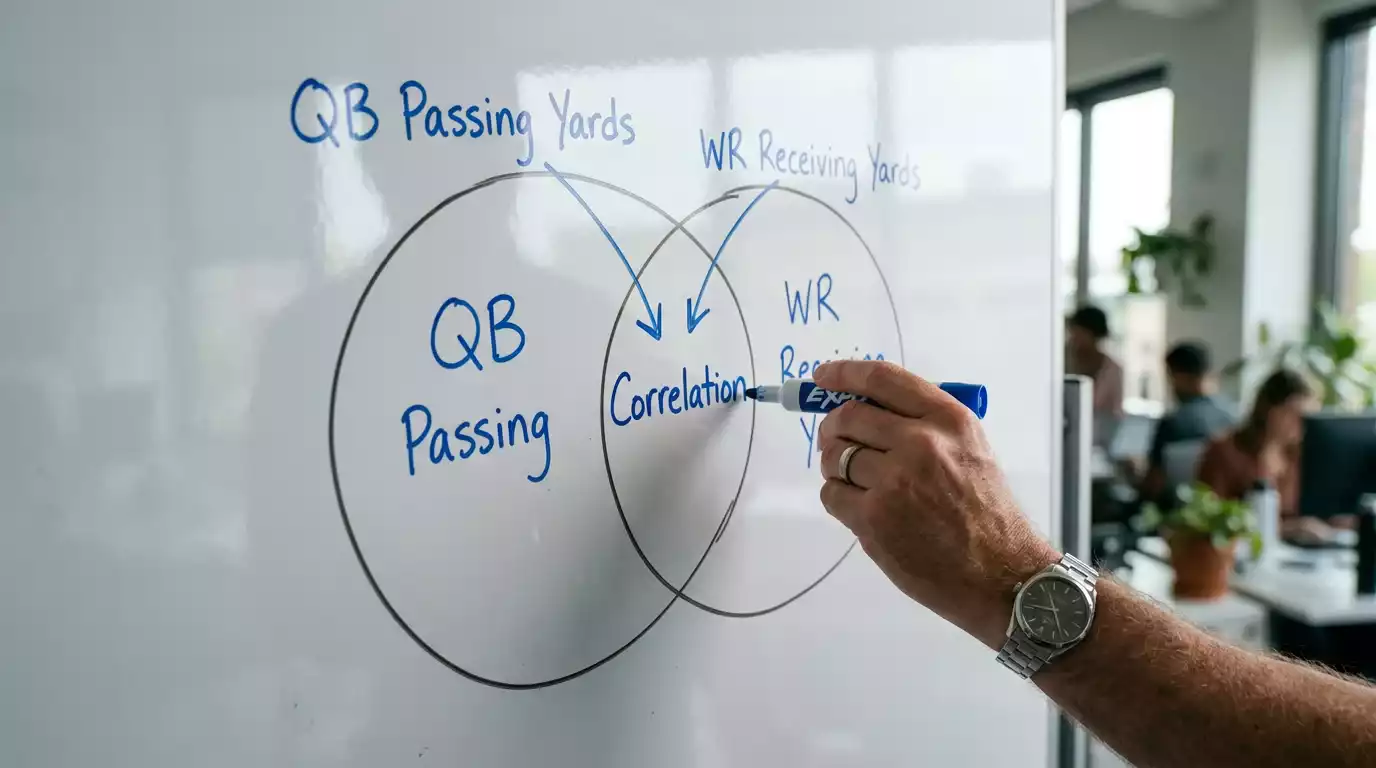
The first time I tried to build a same-game parlay, I combined a quarterback’s passing yards over with his top receiver’s receiving yards over. It felt logical – if the quarterback throws a lot, his best receiver catches a lot. Both legs hit, but the payout was disappointingly low. The sportsbook had priced the correlation between those two outcomes and charged me for it. That invisible surcharge – what the industry calls the correlation tax – is one of the most misunderstood mechanics in NFL prop betting, and it shapes every multi-leg bet you place.
Same-game parlays represented more than 25% of the total Super Bowl handle per Sportsepreneur reporting. The SGP product has exploded in popularity, but the correlation adjustments baked into the pricing mean most bettors are paying more than they realise for the convenience of combining related props. Understanding how correlation works – both for and against you – is essential before building any multi-leg prop bet.
Positive and Negative Prop Correlation Pricing
Two props are positively correlated when one outcome makes the other more likely. If a quarterback throws for 300 yards, the odds that his primary receiver has a big yardage game increase – the quarterback’s production flows partly through that receiver. Similarly, if a team’s game total goes over, the individual scoring props for that team’s players become more likely to hit. These are intuitive connections that every bettor recognises, and the sportsbook recognises them too.
Negative correlation works in reverse: one outcome makes the other less likely. If a running back rushes for 140 yards, the team probably had a lead and ran the ball to kill clock – which means the quarterback likely had a modest passing day. The running back’s over correlates negatively with the quarterback’s passing yards over. Combining these two in a parlay is harder to hit than the individual probabilities suggest, because the game conditions that favour one tend to suppress the other.
Then there are the outcomes that appear correlated but aren’t. A quarterback’s interception count and the opposing defensive back’s interception prop seem connected – if the QB throws picks, someone on the other team catches them. But the specific defender who intercepts is essentially random. The team-level interception total correlates with the quarterback’s interception over, but the individual defender’s interception prop is too unpredictable to call correlated in a useful sense. Mistaking noise for correlation is one of the analytical traps that separates profitable SGP bettors from those subsidising the sportsbook.
In Maryland, parlays constituted 36% of handle but produced 63% of sportsbook revenue per Legal Sports Report data. That revenue concentration reflects the compounding of both vig and correlation penalties across the legs of multi-bet products.
How Sportsbooks Price Correlated Legs in SGPs
When you build a traditional multi-game parlay, the sportsbook multiplies the individual odds because the outcomes are independent – one game doesn’t influence another. In a same-game parlay, the legs aren’t independent. The sportsbook’s pricing engine uses a correlation model to adjust the combined odds downward (reducing your payout) for positively correlated legs and, in theory, upward for negatively correlated legs.
In practice, the adjustment is asymmetric. Sportsbooks aggressively reduce payouts for positive correlation – the “obvious” combinations like quarterback passing plus receiver receiving – but they rarely increase payouts proportionally for negative correlation. The result is a systematic pricing edge for the house. You pay the full penalty for combining related props but don’t receive the full benefit for combining opposing ones.
The specific correlation model varies by sportsbook, and none of them publish their methodology. What I’ve observed through years of reverse-engineering payouts is that the penalty increases with the strength of the correlation. Combining a quarterback’s passing yards with his top target’s receiving yards might cost you 15-20% of the payout compared to what simple multiplication would give. Combining a quarterback’s passing yards with the game total over might cost you 5-10%. The stronger the link, the steeper the tax.
In New Jersey, parlays accounted for 27% of handle but generated 72.5% of revenue per state regulatory data. That revenue ratio is sustained not just by the compounding vig on each leg but by the correlation adjustments that systematically reduce payouts below mathematically fair prices.
Leveraging Negative Correlation in Multi-Game Parlays
If same-game parlays penalise positive correlation, the logical response is to seek negative correlation – or to avoid same-game parlays entirely and build multi-game parlays where the legs are truly independent.
Multi-game parlays combine props from different games, which eliminates the correlation problem. A quarterback’s passing yards in the 18:00 GMT game has no causal relationship with a running back’s rushing yards in the 21:25 GMT game. The sportsbook prices these as independent events and simply multiplies the odds. You still pay compounding vig on each leg, but you avoid the correlation tax entirely. For bettors who want the payout potential of a parlay without the correlation penalty, multi-game parlays are structurally fairer.
Within a single game, negatively correlated legs offer a different kind of edge – but only if the sportsbook’s pricing engine gives you credit for the negative correlation. As I mentioned, the credit is usually less generous than the penalty, but it does exist. Combining a team’s running back rushing yards over with the opposing quarterback’s passing yards under is a game-script bet: you’re wagering that one team dominates on the ground while the other struggles through the air. If the game unfolds that way, both legs hit. The sportsbook’s model should recognise the negative correlation and give you a slightly better combined price than simple multiplication.
My approach to SGPs is conservative: I build them rarely, only with uncorrelated or negatively correlated legs, and only when each individual leg has positive expected value on its own. If a leg doesn’t pass the standalone EV test, it doesn’t belong in a parlay – the combination can’t rescue a bad individual selection. That discipline keeps me out of the “fun” parlays that the sportsbook promotes and focused on the narrow scenarios where the maths actually works. For the full breakdown of how compounding vig amplifies the cost of every parlay leg, the SGP guide walks through the step-by-step calculations.
Are positively correlated prop legs always a bad idea in a same-game parlay?
Not always, but they carry a pricing penalty that makes them expensive. The sportsbook reduces the payout on positively correlated legs because one hitting makes the other more likely. You need a larger edge on each individual leg to overcome this penalty. If both legs are genuinely positive EV on their own and the correlation adjustment is modest, the combination can still be worthwhile — but it demands rigorous evaluation rather than casual combination.
What is an example of negatively correlated NFL player props?
A running back’s rushing yards over and the same team’s quarterback passing yards under is a classic negative correlation. If the running back dominates, the team is likely ahead and running the clock, which suppresses passing volume. Another example: a team’s total points over combined with the opposing quarterback’s passing yards under — if the team scores heavily, the opponent is trailing and may abandon the run, but the winning team’s defence might also be playing conservatively.
Published by the nfl Best Player Prop Bets team.