NFL Prop Bets Data Sources and Analytics
 Available in US
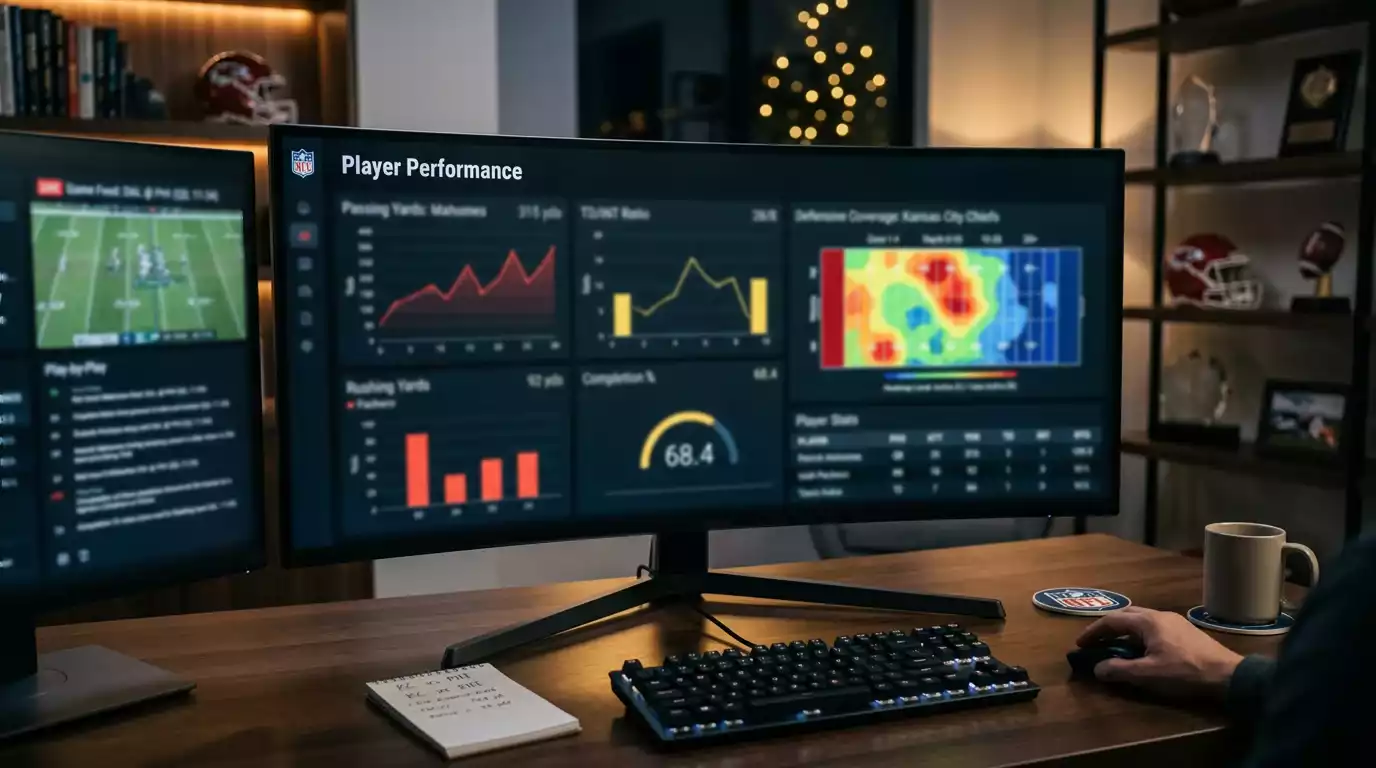
When I started analysing NFL props seriously, my data sources were a notebook and the stats page on the NFL’s website. It took me two seasons to discover that the free data I was using captured maybe 30% of the information available. The rest – route participation rates, pressure metrics, coverage assignments, air yards distributions – lived in platforms I hadn’t heard of, some free and some behind a paywall. Knowing where to find the right data doesn’t guarantee you’ll make the right bets, but it guarantees you won’t be making decisions in the dark while the sportsbook operates with the lights on.
The UK accounts for roughly 3% of the NFL’s global web audience per Hyperset Group data, and since 95% of UK bets are placed online according to industry figures, every data source I’m about to describe is accessible from a laptop in London exactly as it is from one in New York. Geography isn’t the barrier. Knowing what to look for is.
NFL Prop Analysis Free Statistical Data
The NFL’s own statistics portal provides the basics: passing, rushing, receiving, and defensive stats for every player, updated within hours of each game. It’s the starting point for any prop evaluation – season averages, game logs, and splits by home/away or indoor/outdoor. The limitation is depth. The NFL portal tells you that a receiver averaged 78 yards per game but doesn’t tell you his target share, his average depth of target, or his yards per route run. For surface-level analysis, it’s sufficient. For serious prop work, it’s a floor, not a ceiling.
Pro Football Reference is the most comprehensive free database available. It covers historical data stretching back decades, advanced metrics like approximate value and adjusted yards per attempt, and game-by-game logs that let you trace performance trends across a season. I use it for two things primarily: comparing a player’s current production against his career baseline, and identifying statistical splits that reveal matchup vulnerabilities. The site’s fantasy football section, counterintuitively, is one of the best tools for prop analysis because the per-game projections translate directly into expected stat lines.
Football Outsiders publishes DVOA – the defensive efficiency metric I consider the single most predictive stat for prop analysis. Their team-level and opponent-adjusted metrics are free to browse, and the premium content adds play-level granularity. For UK bettors who want to assess how a defence performs against specific positions, Football Outsiders’ breakdowns by rushing versus passing and by position group are invaluable.
The NFL’s Next Gen Stats platform offers tracking data that no other free source provides: player speed, separation distance, time to throw, and route charts. This data comes directly from chips embedded in players’ shoulder pads and the football itself. For receiver props, separation data tells you whether a receiver is genuinely getting open or whether he’s catching contested passes that are less likely to continue at the same rate. For quarterback props, time to throw reveals how quickly the offensive line breaks down and how the quarterback adjusts.
Paid Platforms and Projection Models Worth Considering
PFF – Pro Football Focus – is the paid platform I use most. PFF grades every player on every play, assigning numerical scores for blocking, coverage, pass rushing, receiving, and more. Their player grades provide a qualitative layer that raw statistics miss: a cornerback might allow a low passer rating against him, but if PFF’s film graders rate him poorly in man coverage, the raw stat is misleading. For prop bettors, PFF’s matchup-specific data – how each defence grades against each position – is the highest-value input behind a paywall.
Projection models like those offered by various analytics sites generate per-game stat estimates that serve as an independent baseline for your own analysis. The best ones adjust for opponent, venue, weather, and injury status. The value isn’t in following their projections blindly – it’s in comparing your estimate to theirs. When you and the model agree that a prop line is mispriced, your confidence increases. When you disagree, it forces you to examine your assumptions.
The cost question is practical. A PFF subscription runs roughly £30-40 per month during the season. Other analytics platforms range from free tiers with limited data to premium tiers at similar price points. For a bettor wagering £50-100 per week on props, a £35 monthly subscription needs to improve your results by less than one percent to pay for itself. For someone betting £10 per week recreationally, the maths doesn’t work – stick with the free sources.
Matching the Right Stat to the Right Prop Type
The most common mistake with data sources is using the wrong stat for the prop you’re evaluating. Passing yards props demand different inputs from touchdown props, which demand different inputs from sack props. A checklist by prop type keeps the analysis focused.
For passing yards props: pass defence DVOA, pressure rate allowed, average time to throw, and neutral-script pass rate. These four metrics capture the defensive environment, the offensive line’s protection quality, and the coaching staff’s play-calling tendencies. Ignore raw passing yards allowed – it’s distorted by game script and opponent quality.
For rushing yards props: yards before contact allowed, stuff rate, and defensive rush DVOA. Add carry share and game-script projection from the offensive side. Rushing props are more about volume and scheme than individual talent, so the team-level metrics carry more weight than the player’s highlight reel.
For receiving yards props: target share, average depth of target, yards per route run, and the opposing cornerback’s coverage grade. Receiving is the most matchup-sensitive prop category, and the cornerback-specific data is where the edge lives. Free sources give you team-level defence rankings; PFF gives you the corner-by-corner breakdown that separates generic analysis from actionable intelligence.
For touchdown props: red zone target share (receivers and tight ends), goal-line carry percentage (running backs), and red zone scoring rate by team. Touchdowns are binary events driven by opportunity inside the twenty-yard line, and the data that predicts them lives in the red zone splits rather than the full-field averages. The tools and calculators that turn these stats into expected value estimates are covered at the prop bet calculator guide.
Can UK bettors access the same NFL data sources as American bettors?
Yes. Every major NFL data platform — the NFL’s statistics portal, Pro Football Reference, Football Outsiders, Next Gen Stats, and paid services like PFF — is accessible from the UK without geographic restriction. The data is identical regardless of your location. The only practical difference is time zone: some data updates after US evening games, which may mean waiting until the following morning UK time for the latest stats.
Which free NFL stat site is most useful for prop bet research?
Pro Football Reference offers the most comprehensive free data for prop analysis, including game logs, splits, advanced metrics, and historical comparisons. For defensive matchup data specifically, Football Outsiders’ DVOA metrics are the most predictive freely available statistics. The NFL’s Next Gen Stats provides unique tracking data on separation, speed, and route information that no other free source matches.
Written by the editors at nfl Best Player Prop Bets.