NFL Prop Bet Calculator and EV Tools
 Available in US
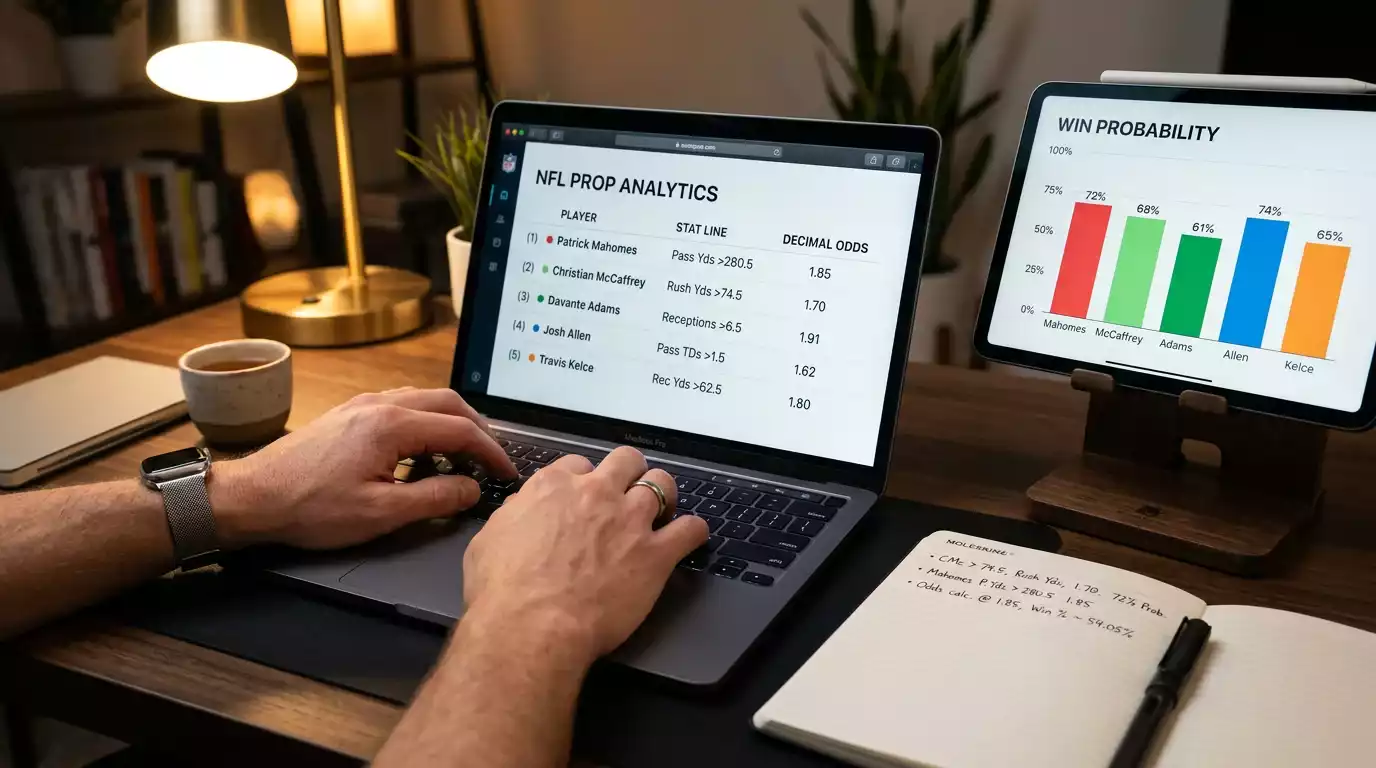
For the first three seasons I bet on NFL props, I did every calculation by hand. Implied probability, expected value, odds conversion – all on a scrap of paper next to my laptop. It worked, but it was slow, and speed matters when lines move. The morning I discovered that a free EV calculator could do in two seconds what took me two minutes changed my workflow permanently. Tools don’t replace thinking, but they eliminate the mechanical friction that slows it down.
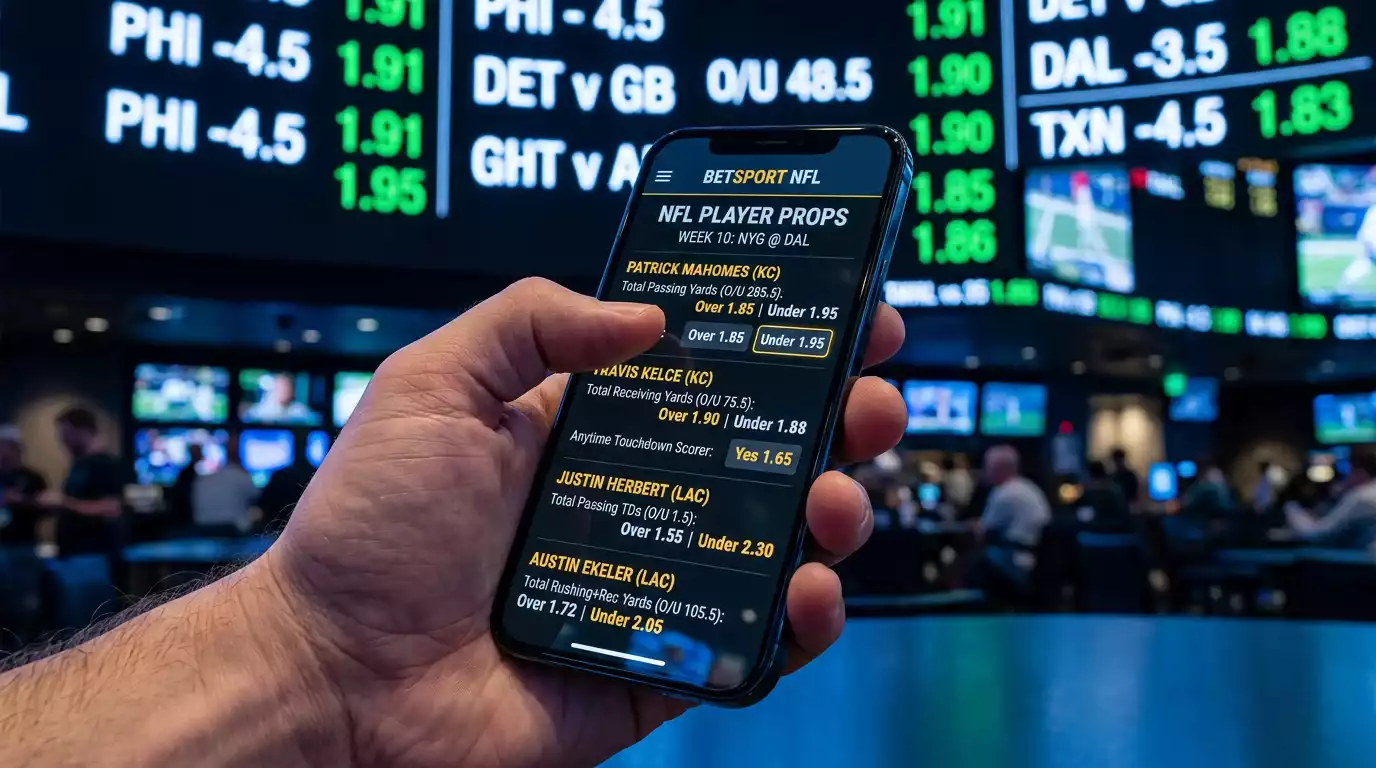
Mobile betting accounts for 78% of all online sports wagers globally according to industry data, which means most prop analysis happens on a phone screen. The calculators and tools available today are built for that reality – quick inputs, instant outputs, and interfaces that work at thumb-speed. Knowing which tools exist and how to use them efficiently is a practical skill that pays for itself across every bet you place.
Expected Value Calculator for NFL Player Props
Expected value is the single number that tells you whether a bet is worth making. It combines the probability you assign to an outcome with the payout the sportsbook offers and produces a figure that represents your average profit or loss per pound wagered. If the EV is positive, the bet favours you over the long run. If it’s negative, the sportsbook has the edge.
The formula is simple: EV equals (your estimated probability of winning times the profit if you win) minus (your estimated probability of losing times the stake lost). A prop at decimal odds of 1.91 with a true probability of 55% gives you EV = (0.55 x 0.91) – (0.45 x 1) = 0.50 – 0.45 = +0.05 per unit staked. Positive. Worth betting.
An EV calculator automates this. You enter the decimal odds and your estimated win probability, and the tool returns the expected value instantly. The hold on straight bets sits around 4 – 6% per BettorEdge analysis, so your probability estimate needs to exceed the implied probability by more than that margin for the bet to have positive EV. The calculator makes it trivially easy to check – no mental arithmetic under time pressure.
The hard part isn’t the calculation. It’s the probability estimate. Every EV tool is only as good as the input you give it, and estimating a player’s true probability of hitting an over/under line requires genuine analytical work. The tool eliminates arithmetic error; it doesn’t eliminate analytical error. I use EV calculators as a final check, not a starting point. My analysis determines the probability; the calculator confirms whether the sportsbook’s price creates value at that probability.
Odds Conversion: American to Decimal to Fractional in Seconds
If you read NFL prop analysis from American sources – and you should, because the depth of US-based prop coverage is unmatched – you need to convert American odds to a format your UK platform uses. An odds converter does this instantly, but understanding the underlying logic prevents errors when the tool isn’t handy.
American to decimal: for a negative line like -120, divide 120 by 120 and add 1, giving you 2.00. Wait – that’s wrong. The formula is: divide 100 by the absolute value of the American line and add 1. So -120 becomes 100/120 + 1 = 1.833. For a positive line like +150, divide by 100 and add 1: 150/100 + 1 = 2.50. That’s it. Two formulas, covering every case.
Decimal to fractional: subtract 1 from the decimal odds, then express as a fraction. 1.833 minus 1 = 0.833, which is 5/6. 2.50 minus 1 = 1.50, which is 3/2. Fractional odds are the format most UK horse racing bettors grew up with, but for NFL props I find them less practical than decimal because comparing two similar prices – like 10/11 versus 5/6 – requires more mental work than comparing 1.91 versus 1.83.
The average sportsbook hold has climbed above 9% in recent years per Doc’s Sports tracking, and that growing margin makes it even more important to compare prices accurately across platforms. An odds converter removes the friction from cross-platform comparison, letting you focus on whether the price is right rather than whether you’ve converted it correctly.
Projection Models and How They Generate Prop Estimates
Behind every prop line is a model – a statistical engine that estimates what a player is likely to produce in a given game. Sportsbook models ingest historical data, matchup information, weather, injury status, and dozens of other variables to output a projected stat line. Third-party projection models do the same thing independently, and the gap between a sportsbook’s projection and an independent model’s projection is where bettors find value.
Free projection models exist from several analytics sites, and they’re useful as a baseline. They typically project a player’s expected output based on season averages, opponent adjustments, and basic situational factors. The limitation is granularity – free models rarely account for route distribution, target share trends, or defensive scheme adjustments at the level a serious prop bettor needs.
Paid models go deeper. They incorporate play-by-play data, snap-level tracking, coverage assignments, and real-time line movement signals. The question isn’t whether they’re better than free models – they are – but whether the improvement in projection accuracy is large enough to justify the cost. For someone betting ten props per week at moderate stakes, a subscription that improves accuracy by 2-3% can pay for itself within a few weeks. For a recreational bettor placing two or three bets per Sunday, the free tools are sufficient.
I use a combination of both. Free projections set my baseline. I then adjust manually based on factors the model doesn’t capture – late-breaking injury news, weather shifts, coaching changes. The paid model serves as a cross-reference: if my manual adjustment and the paid model agree, my confidence increases. If they disagree, I investigate why before committing money. That layered approach is more robust than relying on any single tool. For a broader view of how odds and models interact, the guide to NFL player prop odds covers the relationship between pricing and probability in detail.
Do I need a paid projection model to find value in NFL player props?
Not necessarily. Free projection models and public data sources provide a useful baseline for prop analysis. Paid models offer more granularity and accuracy, but the improvement is incremental. If you bet frequently at meaningful stakes, the subscription often pays for itself. For recreational bettors placing a few bets per week, free tools combined with manual research are sufficient.
How accurate are free NFL prop bet calculators?
The calculators themselves are perfectly accurate — they apply mathematical formulas without error. The accuracy of the output depends entirely on the accuracy of the probability estimate you input. A calculator cannot tell you whether a quarterback has a 55% or 60% chance of hitting his passing yards over. It can only tell you what the expected value is at whatever probability you provide.
Written by the editors at nfl Best Player Prop Bets.