NFL Player Prop Odds Comparison
 Available in US
I grew up reading odds in fractions. Evens, 5/4, 11/8 – those numbers made intuitive sense to me before I could do long division. Then I started betting on NFL player props and ran headfirst into a wall of American odds: -110, +135, -125. My first instinct was to convert everything back to fractional. My second, better instinct was to learn decimal odds and never look back.
Roughly 10% of the UK adult population participates in online sports betting, according to Gambling Commission survey data. A meaningful slice of that group is now engaging with NFL markets, where prop odds are often displayed in American format by default, a system designed for a different audience, using a different mathematical convention. The result is a translation problem that costs UK bettors real money, not because the odds themselves are unfair, but because misreading the format leads to miscalculating the value.
This guide is built for UK bettors who want to stop guessing and start calculating. Every section covers a practical skill: converting between formats, extracting the bookmaker’s margin, reading line movement, and comparing prices across platforms. None of it requires a maths degree. All of it requires attention.
Decimal and Fractional Prop Odds Formats
The same prop bet exists in three different numerical languages depending on where you encounter it. A quarterback’s passing yards over 249.5 might be listed as -110 on a US-facing site, 1.91 on a European platform, or 10/11 on a traditional UK bookmaker. All three numbers mean the same thing, but only one of them makes instant calculation easy.
Fractional odds tell you the profit relative to your stake. At 10/11, you profit 10 for every 11 staked. That is clear enough for simple fractions, but it becomes cumbersome when the numbers get awkward – 23/20, 83/100, 8/15. Try calculating implied probability from 83/100 in your head while scrolling through a prop board on your phone. It is not practical.
American odds use a baseline of 100 and split into positive and negative. Negative numbers tell you how much you need to stake to win 100; positive numbers tell you how much you win from a 100 stake. At -110, you stake 110 to win 100. At +135, you stake 100 to win 135. The format is intuitive once you are used to it, but the asymmetric structure – one formula for negatives, a different formula for positives – creates friction when you need to compare lines quickly.
Decimal odds are the simplest format for calculation. The number represents your total return per unit staked, including the stake itself. At 1.91, a one-unit stake returns 1.91 – that is 0.91 in profit plus your original 1.00. The conversion formulas are clean. From American to decimal: if the American odds are negative, divide 100 by the absolute value and add 1. So -110 becomes (100 / 110) + 1 = 1.909. If the American odds are positive, divide by 100 and add 1. So +135 becomes (135 / 100) + 1 = 2.35.
From decimal to fractional: subtract 1, then express the result as a fraction. Decimal 1.91 becomes 0.91, which is 91/100 or approximately 10/11. From fractional to decimal: divide the numerator by the denominator and add 1. So 5/4 becomes (5/4) + 1 = 2.25.
I use decimal odds exclusively for my prop analysis. The format makes expected value calculations trivial, implied probability extraction requires exactly one division, and comparing lines across books takes seconds rather than minutes. Most UK sportsbook apps allow you to switch the display format in your account settings – I recommend doing it once and leaving it on decimal permanently. The conversion will feel unfamiliar for a week. After that, you will wonder why you ever used anything else.
Here is a practical example that illustrates why format matters. Suppose you are comparing a wide receiver’s receiving yards prop across two platforms. Platform A shows -115 (American). Platform B shows 1.87 (decimal). Which is the better price? In American format, -115 converts to decimal as (100/115) + 1 = 1.870. They are identical, but that was not obvious at a glance. Now imagine making that comparison thirty times on a Sunday morning across three platforms and multiple prop types. Decimal format eliminates the conversion step entirely, freeing your attention for the analysis that actually generates edge.
One final note on fractional odds: they remain the default display on several major UK sportsbooks for horse racing and football markets. When you switch to NFL props, the platform may revert to its default. Check your display settings before each session, or you risk misreading a line at the worst possible moment: the thirty seconds between deciding to bet and confirming the slip.
Turning Odds into Probability: What the Numbers Actually Say
Every set of odds on every prop line is a probability statement wearing a price tag. Strip away the formatting, and the bookmaker is telling you exactly how likely they think an outcome is – plus their margin. Learning to read that statement is the single most valuable skill a prop bettor can develop.
The formula is one division: implied probability equals 1 divided by the decimal odds. A prop listed at 1.91 implies a probability of 1 / 1.91 = 52.4%. A prop at 2.10 implies 1 / 2.10 = 47.6%. Simple arithmetic, but the implications are profound. Every time you look at a prop line, you should be asking: do I think this outcome is more or less likely than the number the bookmaker is advertising?
The catch is the overround. On a two-way prop market – over/under on passing yards, for example – the implied probabilities of both sides should add up to 100% if the market were perfectly fair. They never do. If the over is priced at 1.91 (52.4% implied) and the under is also at 1.91 (52.4% implied), the combined total is 104.8%. That extra 4.8% is the overround, and it represents the bookmaker’s built-in margin.
On single player props, sportsbooks typically hold between 4% and 6% of the handle, according to BettorEdge data. That means the overround on a standard two-way prop market sits in a similar range. Compare this to the overround on an NFL spread, which often runs tighter – closer to 4% on the most liquid markets. The wider margin on props reflects the fact that these are lower-volume, less efficient markets where the bookmaker prices in more protection against sharp action.
To extract the true probability from the offered odds, you need to remove the overround. The simplest method is proportional: divide each side’s implied probability by the total. If both sides imply 52.4% and the total is 104.8%, the adjusted probability for each side is 52.4% / 104.8% = 50.0%. That is the bookmaker’s estimated fair probability, stripped of margin. If your own analysis puts the over at 54%, you have a potential edge of four percentage points, a significant gap on a binary market.
I run this calculation on every prop I consider, and it takes about ten seconds per line once you are practised. The discipline of converting odds to probabilities before making a decision transforms your approach from “I think the over will hit” to “the market says 50%, my analysis says 54%, and the edge justifies a bet.” That shift in framing is what separates analytical bettors from recreational ones.
A useful benchmark to carry in your head: on most UK platforms, a standard two-way player prop with both sides at 1.91 carries an overround of roughly 4.7%. If one side is priced at 1.80 and the other at 2.10, the overround is still in the same ballpark – about 5.2%. When you see a prop market where the overround exceeds 7% or 8%, the bookmaker is pricing in extra protection, usually because the market is low-liquidity or the outcome is harder to model. Those wider-margin markets are not inherently bad bets, but the edge you need to identify is correspondingly larger to overcome the additional cost.
What Line Movement Tells You About a Player Prop
Last November, I had my eye on a tight end’s receiving yards prop. The opening line was 48.5 yards on Tuesday morning. By Thursday evening, it had moved to 45.5. No injury report, no weather change, no obvious news. Something – or someone – had pushed that line three full points in two days. That kind of movement tells a story, and reading it correctly is worth more than most statistical models.
Lines move for two reasons: information and money. When a starting cornerback is ruled out on Friday, the opposing wide receiver’s receiving yards line moves up. That is information-driven movement, and it is usually priced in quickly. When a line moves without any corresponding news, the most likely explanation is sharp money, professional bettors placing significant volume on one side, forcing the bookmaker to adjust.
With 290 million online bets placed monthly across the UK according to Statista data, the sheer volume of action means that recreational money can also push lines. But the key distinction is timing. Sharp money tends to hit early in the week, when lines are freshly posted and the bookmaker is most exposed. Public money tends to arrive later, closer to kickoff, following media narratives, fantasy football rankings, and social media tips. If a line moves early and then holds, the early movement was likely sharp. If a line moves late, it is more likely a reflection of public sentiment.
Reverse line movement is particularly useful. This occurs when the majority of public bets are on one side, but the line moves in the opposite direction. If 70% of bets are on the over for a quarterback’s passing yards, yet the line drops from 265.5 to 262.5, the bookmaker is responding to sharp money on the under despite the public leaning over. That divergence is one of the strongest signals in prop betting – the smart money is disagreeing with the crowd, and the bookmaker is siding with the smart money.
For UK bettors, the timing of line movement adds a practical consideration. NFL prop lines typically open on Tuesday or Wednesday US time – late evening in the UK. By Sunday morning GMT, when most UK bettors are making their selections, the lines have already absorbed several days of sharp action. That means the best prices have often been taken before a UK bettor even looks at the board. It is one reason I set alerts for line releases and check them on Wednesday morning rather than waiting for the weekend.
Comparing Prop Odds Across UK-Licensed Sportsbooks
David Santarelli, an analyst who has studied sportsbook economics extensively, noted that hold percentages within the recreational sportsbook model are largely determined by the mix between single-event wagers and parlays. Single-event holds sit in the 4% to 6% range, while parlays run well into double digits. That observation, published by Covers.com, has a direct practical implication for prop bettors: on singles, the margin you are fighting against is relatively small, and it varies between platforms.
With 95% of UK bets placed online according to Gambling Commission data, comparing prop lines across multiple platforms is mechanically simple. Open three apps, search for the same player prop, and note the differences. What you will find, consistently, is that prop lines diverge more between bookmakers than spread or total lines do.
The reason is structural. Game spreads and totals are high-volume markets where the price discovery process is fast and efficient. Dozens of sharp bettors are hitting these lines within minutes of release, forcing convergence. Player props, by contrast, receive less concentrated sharp action, particularly on lower-profile matchups. Sportsbooks set these lines from their internal models, and those models use different inputs, different weightings, and different calibration data. The result is genuine price dispersion.
I have tracked the line differences across three UK-licensed sportsbooks for the last two seasons. On passing yards props, the average gap between the highest and lowest line was 1.8 points. On receiving yards, it was 1.3 points. On rushing yards, it narrowed to 0.9 points. Those may sound like small numbers, but a 1.8-point difference on a passing yards line can shift the expected hit rate by three to four percentage points – enough to flip a negative expected value bet into a positive one.
The odds themselves also vary, even when the line is identical. Two platforms might both offer a passing yards over at 249.5, but one prices it at 1.87 while the other offers 1.93. That 0.06 difference in decimal odds translates directly into a higher payout on the same risk. Over the course of a season, consistently taking the best available price adds cumulative value that compounds significantly. For a deeper exploration of EV tools that automate some of this comparison work, the prop bet calculator guide walks through the practical options.
How to Read a Prop Board on UK Betting Sites
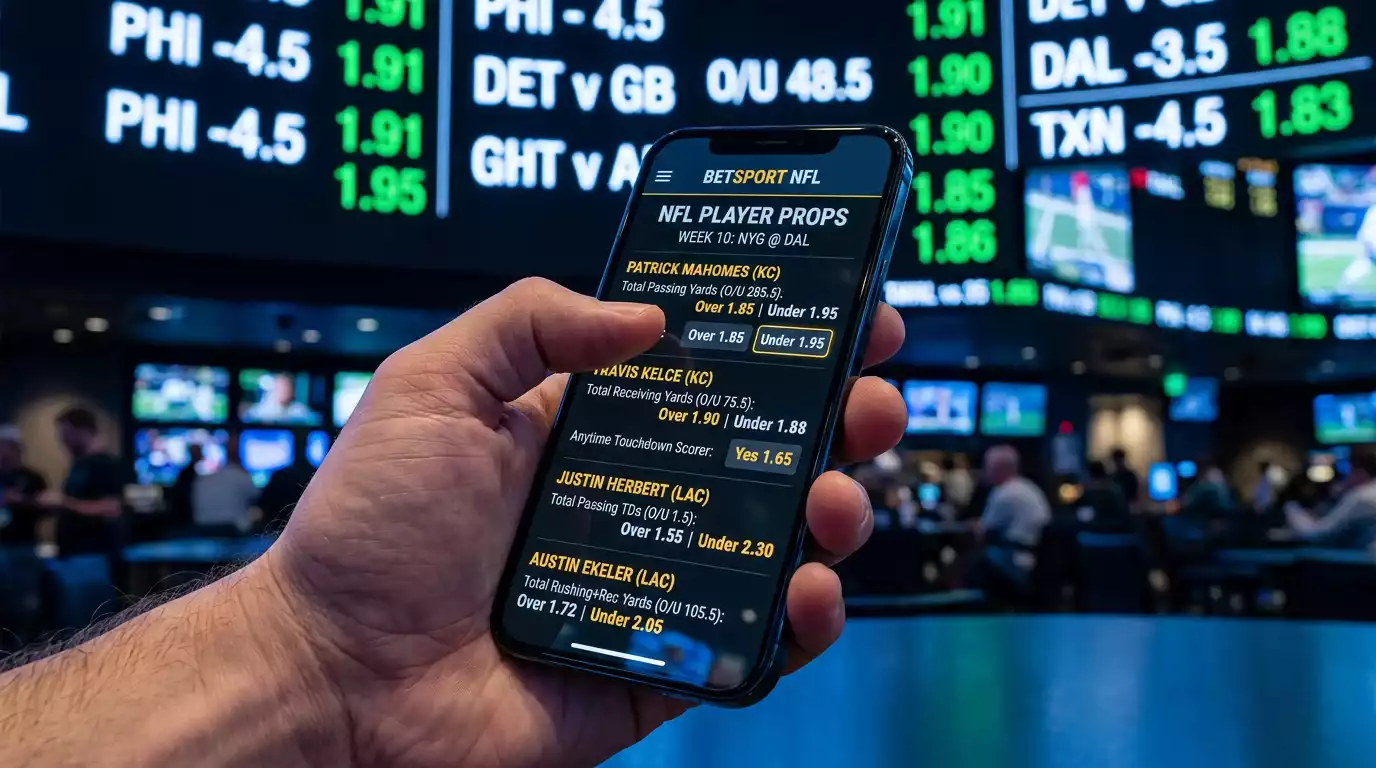
Mobile betting accounts for 78% of all online sports wagers globally, according to Doc’s Sports industry data. That means most UK prop bettors are navigating NFL markets on a screen smaller than a postcard. Understanding how prop boards are laid out on these platforms is a practical skill that saves time and reduces the chance of placing the wrong bet.
On most UK sportsbook apps, NFL player props are organised under the specific match page, typically in a tab or section labelled “Player Props,” “Player Markets,” or “Player Specials.” Within that section, you will find sub-categories: passing props, rushing props, receiving props, and defensive props. Each sub-category lists individual players with their lines and odds for over and under.
The default display usually shows the most popular markets first – anytime touchdown scorer, followed by the headline yards props for the starting quarterback, top running back, and featured receivers. Less common markets, such as completions, interceptions, longest reception, and quarterback rushing yards, require scrolling deeper or expanding additional menus. These less visible markets are precisely where I find the most inefficiency, because fewer bettors are looking at them and the sportsbook’s pricing model has less public action to calibrate against.
One habit worth developing: before scrolling through the prop board for a game, decide in advance which players and prop types you want to evaluate. The sheer volume of options on a modern prop board – a platform might list fifty or more individual player props for a single NFL match – is designed to encourage browsing, and browsing leads to impulse betting. I open the app with a shortlist of three to five specific props I have already researched. I check the lines, compare prices, and either place the bet or move on. The entire interaction takes under two minutes per game.
Filtering by position is useful for efficiency. If my analysis for a particular week has identified value in running back props, I skip straight to the rushing section and ignore the passing markets entirely. If I am focused on a specific quarterback matchup, I look only at passing props and completions. This targeted approach reduces decision fatigue and keeps the process disciplined – two factors that matter more than most bettors appreciate when you are scrolling through a wall of numbers at 5:30 PM on a Sunday afternoon.
A final practical note: always verify that the line on your bet slip matches the line you intended to bet. Sportsbook apps update lines in real time, and the number can shift between the moment you tap a selection and the moment you confirm the wager. Most platforms offer a notification when the odds change, but the line number itself can move silently. I have caught this twice – both times on props where the line moved by a full point while I was adding the selection to my slip. A quick glance before confirming is all it takes.
Reading Odds as a Language, Not a Number
The bettors who consistently find value in NFL prop markets share one trait: they think in probabilities, not in odds. Decimal, fractional, American – these are translation layers. The underlying question is always the same. What is the real probability that this outcome occurs, and is the price I am being offered better than that probability warrants?
Every skill covered here – format conversion, implied probability extraction, line movement analysis, multi-platform comparison, and efficient board navigation – is a tool for answering that question more accurately and more quickly. None of them are complicated. All of them require practice. And the gap between a bettor who uses these tools and one who does not is measured in percentage points of edge that accumulate, bet after bet, across an entire NFL season.
Which odds format is best for calculating prop bet payouts?
Decimal odds are the most efficient format for calculation. The total return on a winning bet is simply the stake multiplied by the decimal number. Implied probability requires only one division: 1 divided by the decimal odds. Fractional and American formats both require additional conversion steps that slow down analysis, particularly when comparing lines across multiple sportsbooks.
What does it mean when a player prop line moves before kickoff?
A line movement before kickoff indicates that either new information has entered the market or significant betting volume has landed on one side. Early-week movement is typically driven by sharp bettors or injury news, while late movement closer to kickoff often reflects public betting patterns. Reverse line movement, where the line moves opposite to the majority of bets, is a particularly strong signal of professional action.
Do UK sportsbooks offer different prop lines than US books?
UK-licensed sportsbooks set their own prop lines using internal models, which can produce different numbers from US platforms. The divergence is usually within 1-2 points on yards props, but even small differences affect expected value. UK platforms may also offer fewer niche prop markets compared to the deepest US books, particularly on lower-profile matchups outside the prime-time slate.
Prepared by the nfl Best Player Prop Bets editorial staff.